
The EU-ETS Review: Conditionality Is Constructive (Part 2), Impact on 2031-40
8 Min. Read Time
In our blogpost yesterday (The EU-ETS Review: Conditionality Is Constructive (Part 1), we looked at the impact of the Commission’s EU-ETS reform package published last Friday on the outlook for the EU-ETS balances over 2026-30, concluding that they were neutral to marginally bullish. In part two of this series, we analyze the impact of the Commission’s proposals, consider the implications for the period 2031-40, and again conclude that the picture from 2031 onwards is more bullish than much of the media and analyst commentary has so far suggested.
For the period 2031-35, we think the conditionality on both the IDB’s 400m allowances and the normal ongoing free allocation volumes means the market will be tighter than at first sight. From 2036 onwards, meanwhile, much will depend on the Commission's determination about the quality of Article 6 (A6) credits available, and on the ability to source the 250m EU-originated Carbon Removal Credits over 2036-40 that the Commission is targeting.
What do the Commission’s proposals imply for the period 2031-40?
The picture post 2030 is more complicated than that for 2026-30 as there are more uncertainties, but in our view there are six main topics of interest, and the most significant as far as the likely impact on the S/D balances over 2031-35 onwards is concerned – but one that attracted the least attention so far – relates to the tougher conditionality on the ongoing allocation of normal free allowances.
The six topics are: i) the LRF and the EUA cap over 2031-40 together with the scope for using Article-6 (A6) credits over 2036-40; ii) the conditionality around the 400m allowances in the Industrial Decarbonization Bank (IDB); iii) the new and surprisingly stringent conditionality around the allocation of normal free allowances over 2031-40; iv) the plan to procure 250m Carbon Removals; v) the proposal to include flights departing the EU up to distances of 5,000km; vi) the fact that CBAM will not now cover 100% of imported products in scope until 2038 instead of 2034.
i) The EUA cap over 2031-40 and the scope for using A6 credits over 2036-40
The Commission has proposed a two-phase reduction in the LRF and, hence, in the EUA cap. First, for the period 2031 to 2035 the LRF will fall to 3.7% from 4.4%; then, for the period 2036-40, the cap will fall to either: i) the default level of 1.7%, with the Commission procuring 260m A6 credits to offset the impact of the higher cap; or, ii) to a more aggressive 2.7% if the Commission is satisfied it can procure 260m high-integrity A6 credits or not. In our calculations, the implied size of the EUA cap for fixed installations under a 1.7% LRF is 294Mt higher than under a 2.7% LRF.
Scenario 1: An LRF of 1.7% with 260m A6 credits centrally procured and then retired/canceled
Figure 1 shows our estimate for the trajectory of the EUA cap for fixed installations over 2031-40, assuming the Commission’s default scenario under which the LRF is set at 3.7% over 2031-35 and then 1.7% over 2036-40, with the Commission procuring 260m A6 credits for direct cancellation so as to offset the impact of the more generous LRF.
In this scenario, the EUA cap is set to align with an 85% domestic emissions-reduction target in the EU by 2040, which is why the A6 credits are cancelled (a total of 5% of the net-90% EU target may be achieved via offsetting with A6 credits, and the EU-ETS share of this 5% is capped at 2%, which equates to the 260m figure).
If EUAs are trading at a higher price than the high-integrity A6 credits purchased, then the surplus revenues raised from selling the 260m EUAs will flow to the IDB. The Commission will publish a report by the end of January 2033 to determine whether sufficient high-quality A6 credits are available and, hence, whether the LRF will fall to 1.7% or 2.7% from 2036.
In total, the EUA cap over 2031-40 under this default scenario would be 4,338 Mt, versus 3,130 Mt under the current ‘Fit-for-55’ legislation, representing an increase of 39%.
Figure 1: CLIFI estimate of EUA cap* over 2031-40 with the default LRF of 1.7% from 2036 (Mt)
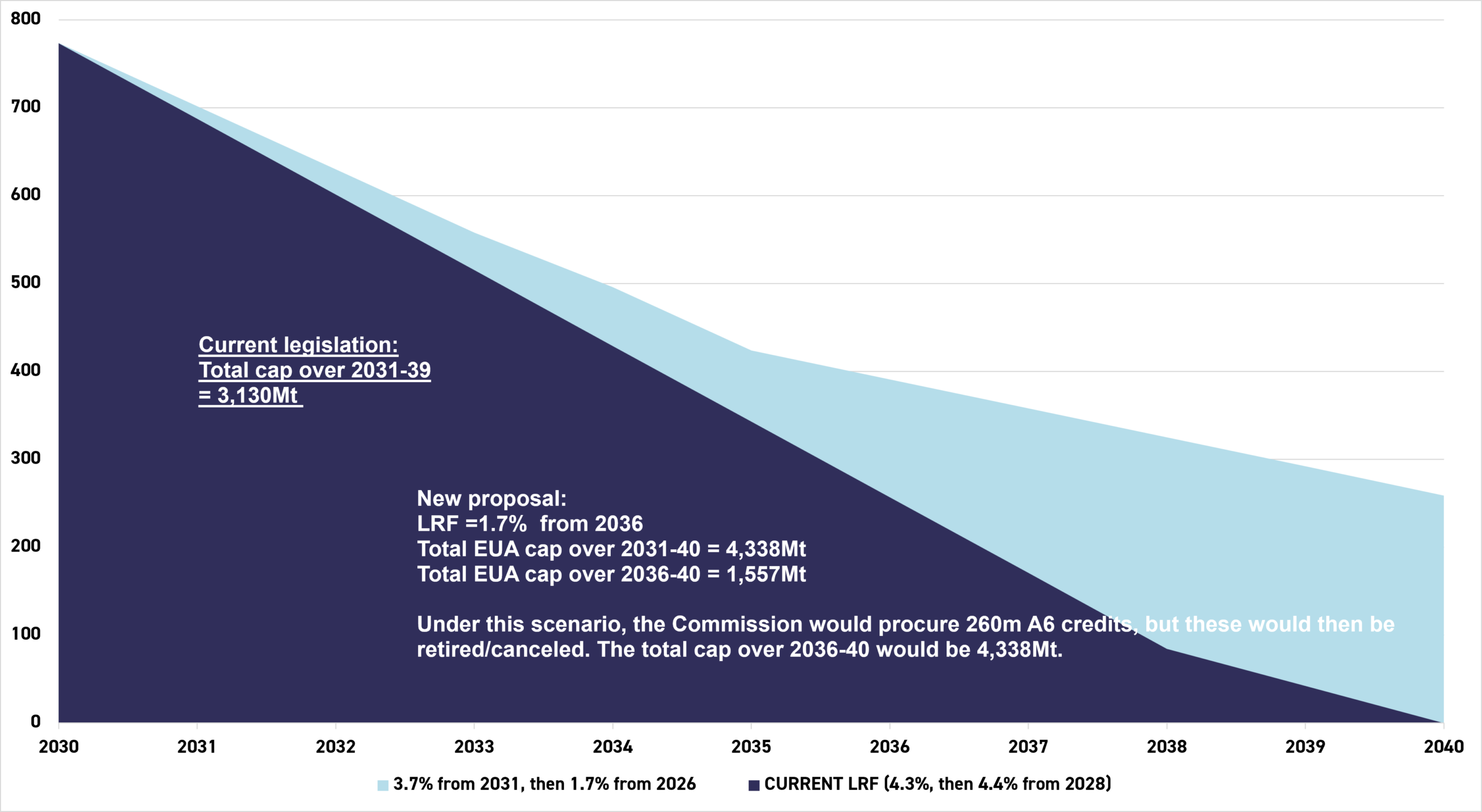
Source: European Commission, CLIFI. *The chart shows a like-for-like comparison between the current legislation and the Commission’s proposed changes under the Review, but for fixed installations only (i.e., excluding the Aviation and Maritime sectors).
Scenario 2: An LRF of 2.7% with no purchase of A6 credits
Figure 2 shows our estimate for the trajectory of the EUA cap over 2031-40, assuming the same 3.7% LRF over 2031-35, but then an LRF of 2.7% over 2036-40. No A6 credits are purchased under this scenario as the LRF is set at a level consistent with achieving the EU’s 2040 net-90% emissions-reduction target entirely domestically (i.e., the gross and net targets would both be 90%).
Figure 2: CLIFI estimate of the EU-ETS cap* over 2031-40 with the default LRF of 2.7% from 2036 (Mt)

Source: European Commission, CLIFI. *The chart shows a like-for-like comparison between the current legislation and the Commission’s proposed changes under the Review, but for fixed installations only (i.e., excluding the Aviation and Maritime sectors).
In total, the EUA cap over 2031-40 under this default scenario would be 4,044 Mt, versus 3,130 Mt under the current ‘Fit-for-55’ legislation, representing an increase of 29%. Under this scenario, 260m allowances would be removed from the cap and assigned to the IDB.
We would note that the difference in the EUA cap between Scenario 1 and Scenario 2 over 2036-40 is 294Mt, which is slightly higher than the extra 260m EUAs set aside for purchasing A6 credits in Scenario 1. We estimate that the LRF under Scenario 1 should be set at 1.8% to eliminate this 34Mt difference.
Also, we note that if either the 1.7% or 2.7% LRFs were continued beyond 2040, the cap would fall to zero in 2048 and 2043, respectively, versus 2039 under the current legislation. However, we view this as extremely unlikely as the EUA cap over the decade 2041-50 will have to be engineered to achieve the 2050 EU-wide net-zero target, whereas the proposed cap(s) to 2040 have been engineered to accord the 2040 net-90% emissions-reduction target.
Finally, we would note that on our more tentative projections for the cap under these two scenarios with the Aviation and Maritime sectors included, we estimate the total EUA cap under Scenario 1 and Scenario 2 would be 4,820Mt and 4,510Mt respectively. Again, this would equate to approximately 39% and 29% higher respectively than the current legislation.
ii) The conditionality around the 400m allowances in the Industrial Decarbonization Bank
The Commission’s reform package establishes the IDB in two phases. Its first phase, the Investment Booster (IB), would operate from 2028 to 2030 and be funded with 400m allowances (although as explained in our blog from yesterday, we expect only 50m of these 400m to come to market by 2030 owing to the strict conditionality attached to qualifying projects).
Then, from 2031, a second phase would provide a further 400m allowances – to be drawn from the cap – through competitive bidding for Carbon Contracts for Difference (CCfDs) or other support mechanisms. The Commission’s proposal states that Phase 2 of the IDB can start before 2031 if the 400m allowances in the IB are exhausted ahead of the end of 2030, but we view this as extremely unlikely given the strong conditionality attached to IB-eligible projects. The envisaged CCfDs would cover the gap between the strike price of the project and the EUA auction price for a period of up to 10 years, and payments to projects would only start once emissions reductions had been verified.
As with the IB, the phased payment profile over a period of up to 10 years, combined with the fact that emissions reductions have to be proven before any payments are made, provides a strong degree of conditionality that should reassure the market that we will not see all 400m allowances in the second phase of the IDB come to market until the second half of the next decade.
iii) The conditionality around normal free allocation
In our view, this is perhaps the most overlooked but also the most significant of the conditionality measures proposed in the entire reform package, as it will significantly delay the allocation of 20% of free allowances to the market over 2031-40. The relevant passage in the EU-ETS Review document establishing the principle of conditionality reads as follows (Commission EU-ETS Review, page 41):
“In view of aligning with the climate neutrality ambition of the EU, starting from the five-year period for free allocation beginning on 1 January 2031, free allocation in the EU ETS should, as a principle, become conditional on establishing a plan to invest in decarbonisation in the EU (‘Invest in EU decarbonisation plan’) and to implementing decarbonisation investments that lead to increased homegrown production of decarbonised and low carbon products as well as to significant reductions in overall climate impacts, including emissions reduction.” (Our emphasis.)
It then goes on to say (page 42):
“80 % of the amount of free allocation for the relevant five-year period for which the application for free allocation is submitted should be allocated in annual tranches with a regular transfer of free allocation after the approval of an Invest in EU decarbonization plan. The remaining 20 % of the amount of allowances to be allocated for free in that five-year period should only be allocated to the installation upon verification that the decarbonisation investments, which can include both captial expenditure (‘CAPEX’) and operating expenditure (‘OPEX’), corresponding to the economic value of 100% of the amount of free allocation for that period, were implemented and that, based on the relevant existing and well-established annual emissions reports, those investments led to significant emissions reduction by the end of the five-year period.”
In other words, the Commission is proposing that free allocation be conditional on EU decarbonization investments, with companies receiving 80% of their free allocation annually upon submitting an approved investment plan once every five years, and the remaining 20% granted only when investments are delivered and emissions reductions verified. Allowances must also be returned if production is relocated outside the EU.
We think this is very bullish for the balances over 2031-35, as a significant portion of the residual 20% of normal free-allocation volumes will probably not make their way to market until 2035 or beyond.
iv) The plan to procure 250m Carbon Removals
The Commission is proposing that 250m EUAs be created outside the cap and auctioned over 2031-2040 to fund the acquisition of a like-for-like amount of domestic permanent Carbon Removal Units (CRUs) in the form of Bio-mass Carbon-Capture-and-Storage credits (BioCCS) and Direct-Air-Capture credits (DACCs). Any removals used for compliance are offset by an equivalent reduction in the additional 250m EUAs auctioned to fund the scheme, limiting the net impact on market balances.
This is bearish, as it raises the cap by 250 Mt, but we note that it is unlikely that any of these 250m allowances set aside for CRUs will come to market before 2035, thereby limiting the impact on S/D balances over 2031-35.
v) Flights departing the EU within a range of up to 5,000km to be included in EU-ETS coverage
For aviation, the Commission is proposing to extend the scope of EU-ETS coverage to all departing flights from the EU up to a range of 5,000 km from the approximate center of the EU (Frankfurt airport in Germany). This scope extension will apply between 2029-2032 after which the continued application of the scope extension will depend on a review of the progress made with CORSIA. Over this 2029-32 period, CORSIA credits will be deductible from ETS compliance costs, with EU-ETS cap increased to match the additional emissions from the increase in coverage. Interestingly, the scope of Aviation coverage will also be extended to private jets.
In our view, this is neutral for S/D balances in the EU-ETS and, by extension, for EUA prices.
vi) Full phase-in of CBAM delayed to 2038 versus 2034
The Commission is proposing that the full phase-in of CBAM be delayed until 2038. For non-CBAM sectors, free allocation would continue during the 2031 2040 period, with no phase-out foreseen under the proposal.
We view this as a neutral proposal as far as the S/D balances are concerned, as it would simply re-allocate allowances from auctioning to free allocation rather than increasing supply, per se.