
The EU-ETS Review: Conditionality Is Constructive (Part 1), Impact on 2026-30 Balances
By Mark Lewis & Climate Finance Partners LLC (CLIFI)
7 Min. Read Time
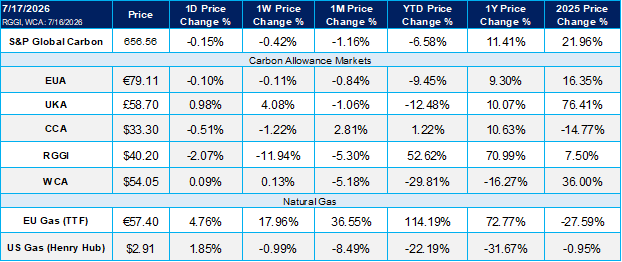
On Friday, July 17, the European Commission presented its long-awaited EU-ETS Review proposals. In the end, the market did not react much on the day, with the benchmark Dec-26 contract settling at €79.11/t, down only 0.1% on Thursday’s close. The reaction in much of the media commentary was that the package looks neutral to marginally bullish over 2026-30 but incrementally bearish from 2031.
The constructive 2026-30 read rests on the Commission's robust conditionality guardrails for the 400m allowances available for free allocation from the Investment Booster before 2030, which make it highly unlikely that anywhere close to the full 400m will be disbursed by 2030.
By contrast, the post-2031 argument is due to the Linear Reduction Factor (LFR) for the EUA cap falling more sharply over the next decade than had been expected (although the LRF will initially fall to a still very robust 3.7% over 2031-35, it is then slated to fall to either 2.7% or 1.7% from 2036 depending on the availability of international credits, with most media commentary on Friday emphasizing the 1.7% number).
Our take is that the package is indeed neutral to marginally bullish over 2026-30 but that the picture from 2031 onwards is more supportive than the media commentary on Friday suggested, and, in this respect, it is interesting to note that the market is reacting more positively in the current trading session than it did on Friday, with the Dec-26 contract up 5% today so far at €83/t as we type.
The reasons for arguing that the outlook over 2031-40 is more constructive than at first sight appear are twofold.
First, the Commission is putting in place strict conditionality guardrails not only for the 400m in the pre-2030 Investment Booster (financial support for qualifing industrial decarbonization projects), but also for both the second tranche of 400m allowances that will be made available for free allocation from 2031 onwards via the Industrial Decarbonization Bank (IDB) and – more significantly still – for the normal volumes of free allocation over the entire 2031-40 period.
Second, while the LRF headlines focused on an LRF of 1.7% from 2036, this 1.7% LRF is conditional on the Commission’s being satisfied that it can source a total of 260m high-integrity international credits – namely Article-6 (A6) credits under the Paris Agreement – over 2036-40. If it determines that this is not possible (and the Commission will make this decision by January 2033), then the EUA cap will fall by 2.7% per year over 2036-40.
This means the EUA cap over 2036-40 will end up being 260m higher under a 1.7% LRF than under a 2.7% LRF, but this will only happen if the Commission ultimately proves able to source the 260m Article-6 credits, with the A6 credits then being used to offset the increase in the EUA cap on a one-for-one basis. In other words, the A6 credits would never enter the EU-ETS as compliance instruments; they would instead be retired/canceled, such that they offset the environmental impact of the increase in the EUA cap. Thus, the Commission would offset the climate impact of the higher EUA cap, but the market would nonetheless get the benefit of the 260 million more EUAs. But to us, this looks like a way for the Commission to retain optionality over supply in 2036-40 rather than a given, and in the end, we may end up with an LRF of 2.7% over the second half of the next decade.
We divide our analysis of the EU-ETS Review into two parts. In the first of two blog posts on the EU-ETS Review, we look at the impact of the Commission’s proposed package on the period 2026-30 in terms of our supply/demand balances through 2030. A second blogpost tomorrow will then look at the impact of the Commission’s proposals on the outlook for 2031-40.
Overall, our updated balances over 2026-30 shown below are essentially flat versus our previous projections, while for the period 2031-35, we think the conditionality on both the IDB’s 400m allowances and on the normal ongoing free allocation volumes means that the market will be tighter than media commentary has so far suggested. From 2036 onwards, much will depend on the Commission's determination of the quality of A6 credits available, and on the ability to source the 260 EU-originated Carbon Removal credits over 2036-40 that the Commission is targeting.
We would emphasize from the outset that the Commission’s proposals will now be debated by the EU Council and the EU Parliament, with a view to reaching a final compromise agreement between the three bodies at some point in 2027. The stated objective is the end of Q1, but we think that is too ambitious for such a large package, as there will inevitably be elements revised during negotiations. Here, though, we focus on the implications of the Commission’s proposals as presented on Friday, as this will drive the market narrative over the next few weeks and months.
What do the Commission’s proposals imply for the balances over 2026-30?
Figure 1 shows our updated base-case scenario for the annual supply/demand balances in the EU-ETS over 2026-30, and Figure 2 our revised base-case scenario for the cumulative surplus. i.e., the Total Number of Allowances in Circulation (TNAC), over 2026-30 (our previous base-case projections for both the balances and the total TNAC were set out in our recent Carbon Crunch blogpost of June 23), following the publication of the EU-ETS Review on Friday.
Figure 1: CLIFI updated EU-ETS base-case scenario for total S/D balances* over 2036-40 (Mt)

Source: European Commission, CLIFI. *Including Aviation and Maritime emissions.
Our revised balances now project a cumulative deficit over 2026-30 of -323Mt (versus -317m previously), resulting in an average annual drawdown of -65Mt over this period, with the total system-wide TNAC falling to 533Mt by the end of 2030 (versus 537Mt previously). We note that our balances for 2026 and 2027 remain unchanged at -136Mt and -79Mt, respectively, and that we still see consecutive annual deficits through to 2030.
There are three main changes to our assumptions over 2028-30 that explain our revised projections.
First, under our previous modeling, we assumed that the 400m allowances in the Investment Booster would be auctioned over the five years 2028-32, with 240m coming to market over 2028-30. In the end, instead of auctioning the 400m allowances, the Commission has decided to allocate them for free, but with a strong degree of conditionality.
The Commission’s proposal is for these allowances to be distributed to companies only when an eligible project has started operating and has been proven to reduce emissions, after which point the allowances will be allocated for free over a subsequent period of up to 10 years. In our view, this means that, in practice, far fewer allowances will come to market by 2030 than we previously assumed, and we have therefore cut our projection from 240m to only 50m (all in 2030).
Figure 2: CLIFI updated cumulative system-wide* EU-ETS inventory (Total TNAC), 2008-30 (Mt)
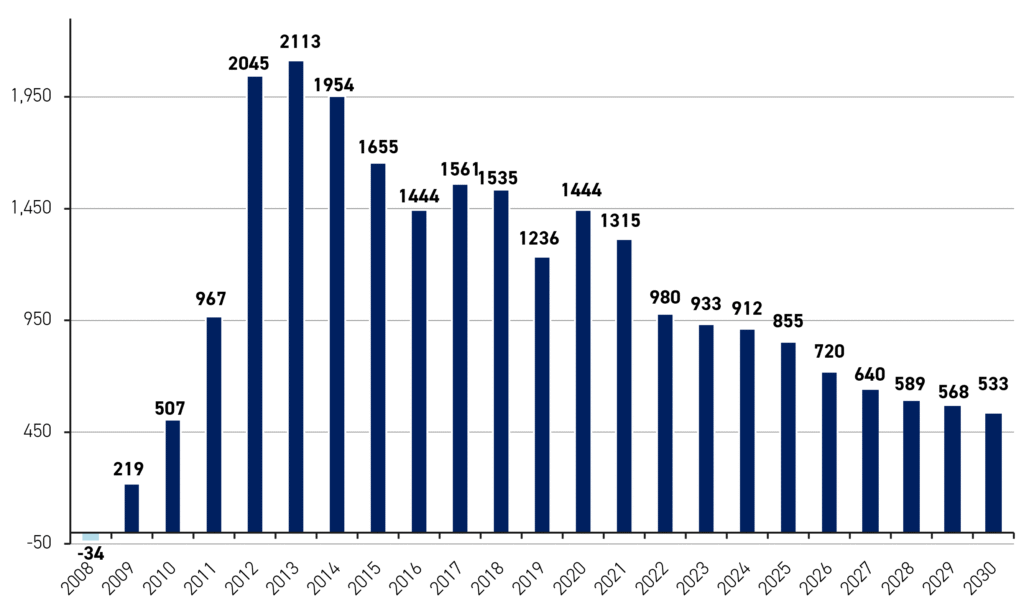
Source: European Commission, CLIFI. *This number represents the TNAC number published by the European Commission every year adjusted to include the cumulative Aviation deficit from 2012 not just from 2024. This explains why this system-wide cumulative-surplus number is materially lower than the TNAC number as published by the European Commission for the years prior to 2027. However, starting from the 2027 TNAC number to be published in May 2028, the Commission’s TNAC calculation will be revised to include the cumulative Aviation deficit over 2012-23 such that from 2027 onwards the Commission’s TNAC calculation will be consistent with the one we have always used to gauge the true level of outstanding EUA inventory.
Second, we have included an extra 80m of EUA supply from the Commission’s plan to set aside an extra €6bn worth of allowances to provide a greater cushion against the fallback benchmarks for energy-intensive industry (27m per year over 2028-30).
Third, and in line with the Commission’s proposal in the Review that we had suspected might be forthcoming (see our recent Moment of Truth for EU-ETS blogpost of July 14), we have changed the method for calculating the TNAC that the Commission uses for determining the amount of allowances to be placed in the Market Stability Reserve (MSR) every year. The new methodology – which will come into effect as of the end of 2027 – will include the cumulative deficit of Aviation from 2012, as opposed to the current methodology, which only includes the Aviation balance from 2024. In our view, this is a positive move as it will bring the outstanding market inventory (TNAC) as calculated by the Commission every year into line with the actual underlying TNAC.
However, where the Commission’s package differed from our expectations is that it has not made any one-off change to the upper Market Stability Reserve threshold of 833m to reflect the lower TNAC number, with the upper and lower MSR thresholds now set to fall by 4% per year from 2029, and the intake rate to fall to 12% from 24%. In effect, the MSR acts as an automatic supply management system for the EU ETS, removing allowances when there is a large surplus (above the upper threshold) and, in theory, returning allowances when the market becomes too tight (below the lower threshold). This mechanism has been one of the primary drivers of tightening EU ETS supply over the past several years.
The future design of the MSR means that the TNAC will be materially below the 833m threshold from 2028 onwards, such that no more allowances will be removed from 2029. As a result, in our revised base-case projections, the MSR removes only 74Mt from auction volumes over 2028-30 (versus 181Mt previously). Moreover, even with the upper MSR threshold falling by 4% per year from 2029, we do not expect the MSR to ever remove allowances from auction volumes again after 2028.
Overall, we think the Commission’s proposals are broadly neutral versus our previous base-case scenario over 2026-30, and still see a bullish story through 2030 with the balances particularly tight this year and next.
We will review the impact of the Commission’s reform package on the outlook for the EU-ETS over 2031-40 in a second blog post tomorrow.
Carbon Market Roundup
EUAs closed at €79.11, down 0.11% on the week, while UKAs rose to £58.70, up 4.08%. In North America, CCA prices eased to $33.30, down 1.22%, and RGGI allowances fell to $40.20, down 11.94%. WCA ticked higher to $54.05, up 0.13% over the period.