
Washington Auction Shows Market Betting on Linkage, EU-ETS Negotiations in View
By Mark Lewis & Climate Finance Partners LLC (CLIFI)
4 Min. Read Time
Washington’s Q3 auction results were published yesterday, with the auction clearing at $39.50/t, below the secondary-market price prevailing ahead of the results and down from $64.56/t in Q2; the Dec-26 contract subsequently closed at $44.50/t versus $54.85/t on Tuesday. However, demand remained strong, with bids totaling 1.88 times the allowances offered (i.e., cover ratio), with the clearing price therefore indicating that market participants now firmly expect Washington to join the Western Climate Initiative (WCI) program in 2027.
In Europe, policymakers in EU member states and the EU Parliament are now back from their summer holidays and the debate over the European Commission’s proposals in the EU-ETS Review published in July will now start warming up. Meanwhile, the continuing strength in EU natural-gas prices has also drawn attention, with the front-month natural gas price at the Title Transfer Facility (TTF) hub trading above €80/MWh yesterday. So far, EUAs have tracked modestly higher in the face of this TTF strength, but in our view higher natural-gas prices – together with the higher power prices they entail – could pose a real political challenge as they will highlight the issue of the EU’s industrial competitiveness just as the negotiations get serious.
California reform approval allows implementation of market reform package from September 1
Washington’s Q3 current auction sold all 6.3 million current-vintage WCAs, with the clearing price of $39.50/t, 39% below the Q2 clearing price of $64.56/t, reflecting a consolidation toward California prices amid expectations of future linkage. As such the Q3 clearing price was also 40% below the 2026 Allowance Price Containment Reserve (APCR) Tier-1 level of $65.26/t. The Tier 1 level marks a trigger price where if auction prices clear above the pre-determined tier level, additional allowances from the APCR are released into the market to help stablize prices.
Nonetheless, bidding interest was strong, with the cover ratio of 1.88x marginally more robust than at the previous four auctions. We take this outcome as indicating a consensus in the market that Washington will join the join California and Quebec Western Climate Initiative (WCI) program before the compliance deadline for November 2027, such that compliance entities in the Evergreen state will most probably not need to rely on additional APCR auctions to meet their compliance needs.
Given the low settlement price the Q3 auction will not trigger an additional APCR auction but there will nonetheless still be two more APCR auctions this year. The first – prompted by the Q1 auction settling at the APCR level – will take place on September 30, and the second will be held before November’s interim compliance deadline, as mandated by the program’s regulations.
In the secondary market, prices dropped nearly 20% after news of the auction result, with the Dec-26 contract settling at $44.5/t yesterday. This is still significantly above the equivalent CCA-vintage price, which closed at $32.88/t yesterday, but if the process of linking Washington with the WCI program runs smoothly from here we would expect further convergence between WCAs and CCAs, with WCAs falling further and CCAs grinding up steadily over the next 12 months.
EUAs slightly higher as TTF breaks €80/MWh but this will complicate EU-ETS negotiations
EUAs have had a good week so far, trading through €85/t for the first time since January 28 this year. However, we remain cautious about the near-term upside from here given the ongoing increase in nat gas TTF prices. The benchmark front-month TTF contract traded above €80/MWh yesterday for the first time since January 2023, a three-and-a-half year high, and this morning it has traded above 81/MWh. Figure 1 shows EUAs versus TTF since the beginning of August.
As we have consistently highlighted in this blog (most recently in last week’s post), the higher the TTF price goes the more difficult the political context for EUAs becomes. As a result, and notwithstanding the fact that the much higher natural-gas prices of the last month have made coal more competitive for power generation (thereby prompting a short-term increase in the demand for EUAs), we think the risk for EUAs is rising.
Moreover, the timing of this move in TTF is tricky, coming just as the trilogue negotiations between the Commission, Council, and Parliament on the EU-ETS reform package about to get serious later this month and into Q4.
Figure 1: Front-Dec EUA (LHS, €/t) versus Front-Month TTF (RHS, €/MWh) July 31 – Sep 9, 2026

Source: Bloomberg
The Parliament’s EU-ETS rapporteur, Peter Liese, released a draft report today on the proposals:
- The European Union's lead lawmaker on carbon market reform is considering proposing a smoother pace of emissions cuts next decade in a draft plan.
- The draft plan would reduce the pollution cap in the Emissions Trading System by 3.4% every year in the first half of the 2030s and by 2.3% in the second half v.s. the earlier proposed 3.7% and 1.7% decline, respectively.
- The report will propose including carbon dioxide removals in 2029 and introduce a mechanism to help avoid excessive price swings, and will become the basis for the parliament's position on the overhaul of the ETS.
The most important point here, we think, is the third, namely the expected proposal of ‘a mechanism to avoid excessive price swings’. If this is indeed what Liese proposes, we would expect support from many EU member states, especially if TTF continues to rise as we head into winter.
Accordingly, TTF prices will be key to political sentiment on the EU-ETS reform negotiations in the coming weeks, and we would continue expect a correction in EUA prices in Q4 if TTF prices move higher still from here.
Carbon Market Roundup
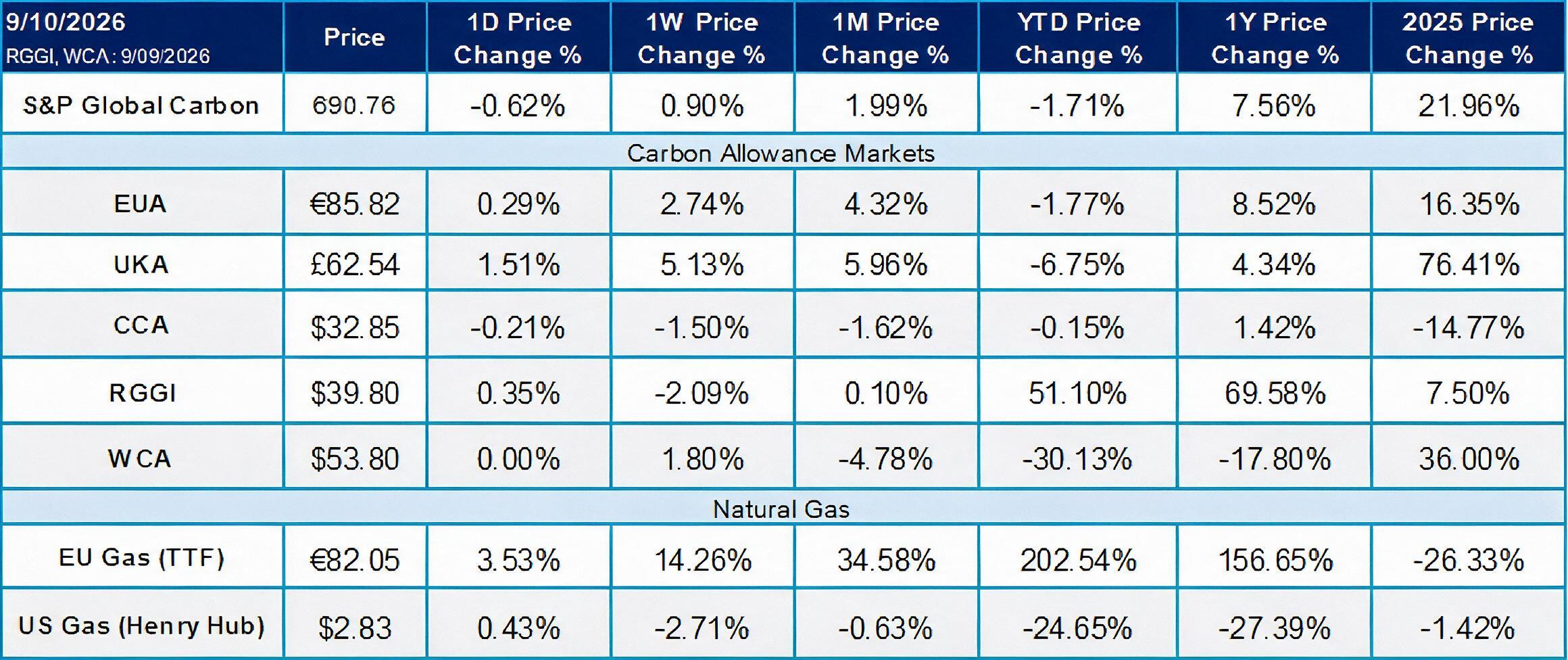
The S&P Global Carbon index was up 0.90% over the week.EUAs rose to €85.82, gaining 2.74% week over week, while UKAs climbed to £62.54, up 5.13%. In North America, CCA prices eased to $32.85, down 1.50% over the week, while RGGI allowances fell to $39.80, down 2.09%. WCA moved higher to $53.80, up 1.80% over the period.