
California Reform Package Clears Final Hurdle, EUAs Continue to Tread Water
By Mark Lewis & Climate Finance Partners LLC (CLIFI)
4 Min. Read Time
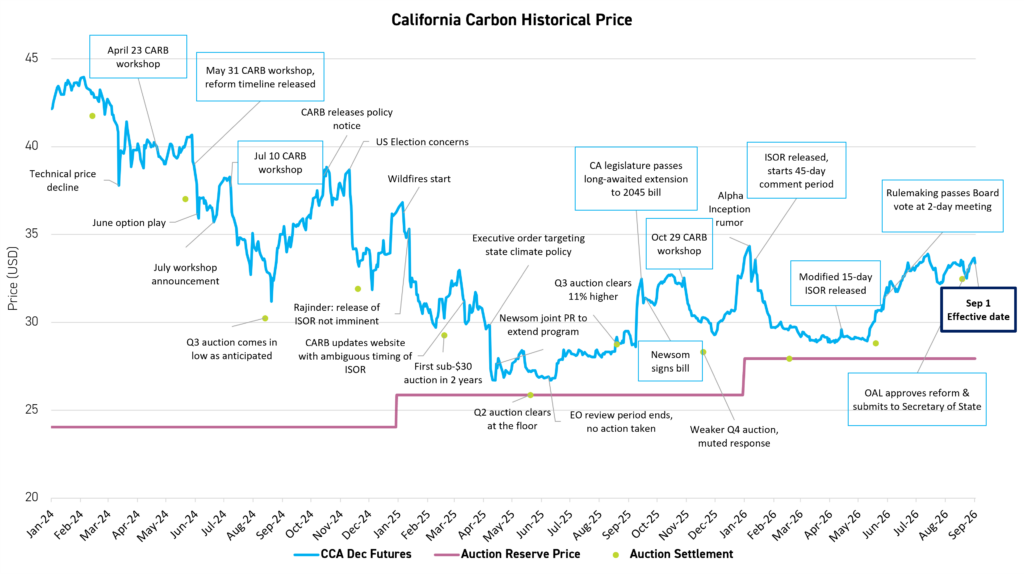
California’s Office of Administrative Law (OAL) approved the state's cap and invest reform package, known as the Final Statement of Reasons (FSOR), on Monday, clearing the way for the new market policies to take effect as planned on September 1. This approval is a huge milestone in the history of California’s carbon market and should now pave the way for CCAs to move structurally higher over the next 12-24 months.
In Europe, EUAs have continued to trade in a range of €81-84/t this week, but as we highlighted in last week’s blog, the recent strength in EU natural-gas prices is a concern, and yesterday the front-month price at the Title Transfer Facility (TTF) hub traded briefly above €75/MWh, another new two-year high. This makes for a testing political backdrop to the negotiations over the EU-ETS Review as these ramp up later this month.
OAL approval allows implementation of CCA reform package from September 1
On Monday, August 31, CARB notified the market that the OAL had approved the Final Statement of Reasons (FSOR), confirming that the cap-and-invest reform package would take effect as planned on 1 September. With this approval, CARB cleared the final hurdle in the process of reviewing and revising the state’s Cap-and-Invest Program, a process that began all the way back in 2022. This means that the market can now focus on the substance of the reform and on the tightening fundamentals of the market through 2030 and beyond.
As summarized in the FSOR approved at the CARB Board Meeting of May 28-29 and then submitted to the OAL on July 14, the reform package foresees an ambitious reduction in California’s emissions through 2045 in line with the Golden State’s 2045 net-zero emissions target:
The suite of Proposed Amendments to the Cap-and-Invest Regulation works collectively to ensure the Program provides the long-term price signal and appropriate incentives to support the 2030 target and align with the trajectory for the economy-wide deep decarbonization needed through mid-century. Most significantly, staff propose to revise allowance budgets through 2045 by removing over 1 billion allowances to align with the technical adjustments to the GHG Emissions Inventory and to support achieving the legislative GHG emissions reduction targets for 2030 and 2045. These proposed changes to allowance budgets would increase the stringency of the Program, intensifying incentives for covered entities to invest in GHG emissions reduction activities in the near- and long-term.
The Dec-26 contract has traded in a narrow range of $33.3-$33.6/t since the OAL judgment was announced on Monday, essentially flat against last Friday’s close, indicating that the market had already priced in a positive verdict from the OAL.
From now on, however, with the reform already taking effect from earlier this week, we now expect a gradual price appreciation over the next 12-24 months as compliance players look to build inventory and investors look to profit from the tighter balances that will hit through 2030.
EUAs have traded in a tight range over the last month but TTF up 40% over same period
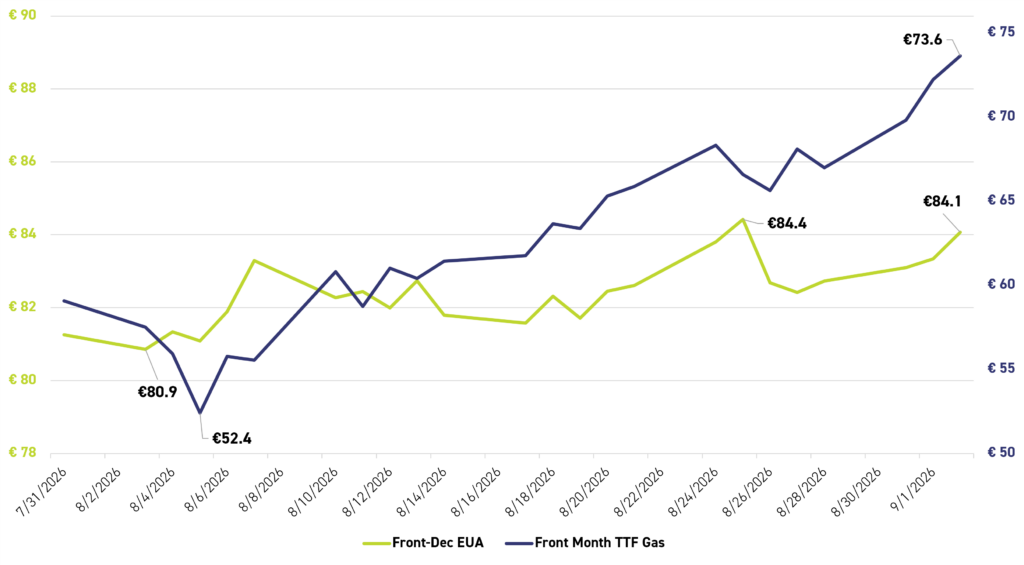
Figure 1 shows EUAs versus TTF since July 31. Over this period, EUAs have traded in a narrow 5% range, with a closing low of €80.9/t on August 3, and a high of €84.4/t on August 25. Over the same period, TTF nat gas has traded in a much wider 40% range, with the lowest settlement over this period being €52.4/MWh on August 4, and the highest €73.6/MWh last night.
We remain cautious about the recent strength in TTF prices because, as we have discussed many times in our blogs throughout this year (see, for example, our post of last week and, for a fuller explanation, our post of March 16), EUAs and natural gas prices have exhibited a strong inverse correlation in recent months, extending back to the beginning of 2025. Higher natural gas prices can weigh on the competitiveness of European industry and, in turn, increase political pressure from member states concerned about the impact on their industrial base, potentially creating headwinds for the EU ETS. When TTF prices move above the €60/MWh threshold, the political sensitivity around carbon policy tends to increase, with prices at €70/MWh and above potentially bringing additional focus to the competitiveness of European industry.
Figure 1: Front-Dec EUA (LHS, €/t) versus Front-Month TTF (RHS, €/MWh) July 31 – Sep 2, 2026
So why have EUAs held up so well over the last month in the face of the 40% rally in TTF?
We think the main reason for this is that the much higher natural gas prices over the last month have made coal more competitive for power generation, prompting a short-term increase in demand for EUAs (coal is twice as carbon-intensive as natural gas when burned for power generation).
However, coal generation is now maxed out in our view, so any further increase in TTF prices from here will not increase demand for EUAs from power generators. Instead, we think the risk is that any further increase in TTF prices from here will raise the political pressure on the EU-ETS just as the trilogue negotiations between the Commission, Council, and Parliament on the EU-ETS reform package are about to get serious later this month and into Q4.
As a result, we will be watching TTF very carefully in the near term and would expect a correction in EUA prices in Q4 if TTF prices move higher still from here.
Carbon Market Roundup
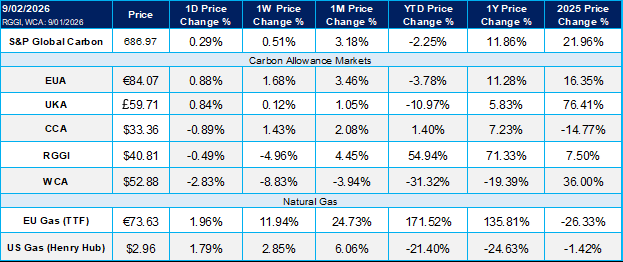
EUAs rose to €84.07, gaining 1.68% week over week, while UKAs were little changed at £59.71, up 0.12%. In North America, CCA prices increased to $33.36, up 1.43% over the week, while RGGI allowances fell to $40.81, down 4.96%. WCA ended at $52.88, down 8.83% over the period.