
Summer Lull in Europe Kicks In as Market Continues to Digest EU-ETS Review
By Mark Lewis & Climate Finance Partners LLC (CLIFI)
3 Min. Read Time
Following the release of the European Commission’s EU-ETS Review package on July 17, European Union carbon allowances (EUAs) rose by as much as 10% in the days that followed, with the benchmark Dec-26 contract settling at a six month high of €86.6/t on July 22 (the highest close since January 27) before trending back down to close out July at €81.3/t, still some 3% higher than the settlement price on the day the reform package was published. United Kingdom carbon allowances (UKAs) have broadly tracked EUAs over the same period (Figure 1).
Figure 1: Front-Dec EUA (LHS, €/t) versus Front-Dec UKA (RHS, €/t*) Jan 1 – July 31, 2026
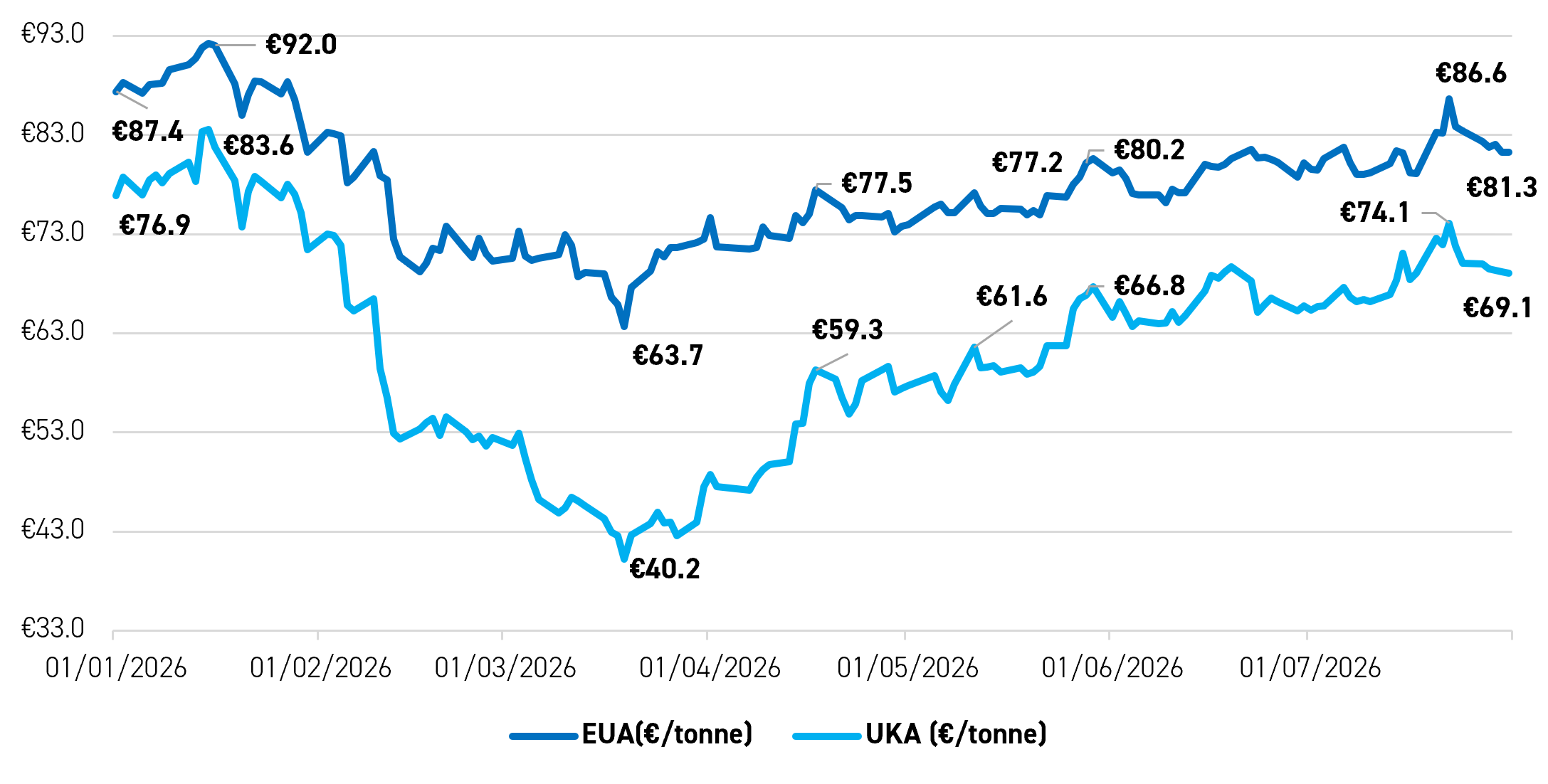
Source: Bloomberg. *Note that we have converted UKA prices into €/tonne here for ease of comparison.
As explained in our two recent blog posts on the Commission’s package (see here for our detailed analysis of the Review’s implications for the balances over 2026-30, and here for our analysis of the implications over 2031-40), the conditionality relates to commitments from EU industry to make investments in decarbonization. As we argued in these blog posts, this conditionality is constructive for EUA prices through 2030 and beyond, as it means a significant chunk of supply will be withheld until new investments are made and emissions reductions from these new investments have been demonstrated.
Decarbonization Investment Support:
- Establishing the Industrial Decarbonisation Bank (IDB) - to provide €100 billion in funding to industrial decarbonisation projects and returning a higher share of EU ETS revenues to sectors covered by the EU ETS. The ETS Investment Booster will kick-start the Bank by rewarding companies that invest early in decarbonisation with an estimated €30 billion as phase I of the Industrial Decarbonisation Bank.
- Strengthening the requirements on how Member States spend ETS auction revenues. Member States will be required to spend 50% of their national ETS revenues on investments to decarbonise ETS sectors.
- Maintaining the Innovation Fund as the key tool to bring low carbon innovation to market and enhance the deployment of clean-tech industries.
Indeed, we estimate that 7% of the total potential supply over 2026-30 will be delayed, with only 50m of the 400m available under the Investment Booster coming to market over this period (and even then, not until 2030). For the period 2031-40, we think the delayed supply will be even greater, with up to 20% of total potential supply being delayed to market (840m allowances out of a total potential supply of 4,338Mt for fixed installations over 2031-40). This breaks down as 400m from the Industrial Decarbonization Bank, 265m from normal free allocations, and 175m from the buffer that will be established to ensure the so-called Cross-Sectoral Correction Factor (an automatic reduction in free allocations when demand exceeds the available allocation budget) is not triggered.
With the EU now entering the peak summer-holiday period and Brussels essentially shutting down for the whole of August, we do not expect any further policy developments until September, when the EU Council (the body that represents EU member-state governments) and the EU Parliament will start formalizing their responses to the Commission’s package.
Nonetheless, it is already clear that there will be strong pushback from EU industry on the stringent conditionality that the Commission has proposed for a significant chunk of the free-allocation volumes over the next decade, with some of the major trade associations for European Industry – for example, CEFIC (the chemical-industry lobby), EUROFER, (the steel-industry lobby), Business Europe (a general business lobby group), and CEPI (the paper-industry lobby) – all having voiced concern on this point.
We think this will put pressure on both Council and Parliament to find some accommodation of industry’s concerns over conditionality, but that this, in turn, will likely mean compromises on the Commission’s proposed cap trajectory, i.e., the Linear Reduction Factor (LRF), and allowed use of Article-6 credits. In other words, the more accommodating some member states and the Parliament want to be on the Commission’s proposed conditionality of supply, the greater the risk that the Commission and the member states that favor a tougher LRF over 2031-40 will be able to get concessions in these areas.
In short, while August should be quiet, we expect greater volatility in September and into Q4 as the trilogue negotiations between the Commission, Council, and Parliament get serious.
Separately, we took time to consider these issues, as well as other elements of the Commission’s package, in the latest edition of the Smarter Markets podcast released on August 1.
Carbon Market Roundup
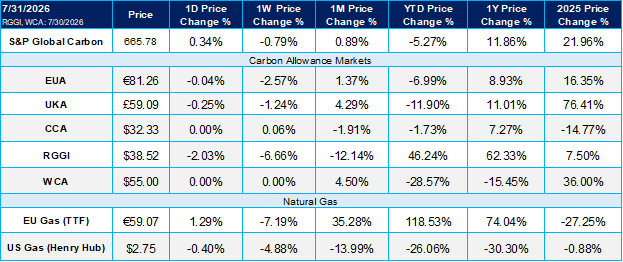
The weighted global price of carbon was $58.87, down 0.79%. EUAs ended at €81.26, down 2.57% on the week, while UKAs slipped to £59.09, down 1.24%. In North America, CCA prices were essentially flat at $32.33, up 0.06%, and RGGI allowances fell to $38.52, down 6.66%. WCA was unchanged at $55.00, flat week-over-week.