

RGGI Q3 Auction Posts New High, EU Parliament Gives Initial View on EU-ETS Reform
By Mark Lewis & Climate Finance Partners LLC (CLIFI)
6 Min. Read Time
Last Friday, the Northeastern power market (RGGI) announced that the Q3 auction settled at $37.65/short ton, up from the previous record of $35/st at the Q2 auction, representing a 4.4% discount to the spot-market price on the day of the auction (versus the 21% discount seen in Q2). Demand was healthy as represented by a cover ratio (bids vs. allowances on offer) of 2.6x, with compliance entities winning only 49% of the allowances offered (versus 51% in Q2). The main driver of the constructive settlement was Virginia's first participation since its return to RGGI after having left the program in 2023, and we expect the market to remain around current levels or even trend higher through the forthcoming compliance deadline in March 2027.
In Europe, the EU Parliament published its initial response to the Commission’s EU-ETS Review package, with the focus on i) the linear reduction factor (LRF) over 2031-40, ii) on removing the Commission’s ambiguity around allowing international credits into the EU-ETS, and iii) on reducing price volatility by making the price-intervention mechanism (Article 29a) more responsive. The market has not been impacted by any of this, with EUAs trading above €88/t Monday, their highest level since late January, as late compliance buying ahead of the September 30 deadline and short covering have so far outweighed the political risk of the ongoing spike in TTF prices. We think this suggests a correction could be forthcoming once the late-compliance buying ends at the end of this month.
The Q3 RGGI auction clears at $37.65, a new all-time high
The Q3-RGGI auction – the 73rd in RGGI’s history – settled at a new all-time-high (ATH) of $37.65/st, and with all 28.5m allowances were comfortably sold (27.4m were current-vintage allowances, and 1.1m were from the Cost Containment Reserve). The 2.6x cover ratio (total bids vs. allowances on offer) was slightly higher than the 2.4x recorded in Q2 but slightly lower than the 2.79x average of the last ten auctions.
Clear Blue Markets (CBM) estimates the total number of RGGI allowances in circulation at around 207m. Given that the auction report indicates 79% of allowances are held for compliance, this implies compliance holdings of 163m. Further, CBM estimates the remaining Control Period compliance obligations at 185 million short tons, suggesting a shortfall of 21.5m allowances. If compliance entities were to win a similar percentage of the allowances on offer at the Q4 auction in December to the 49% they won in Q3, CBM projects that they would still need a further 6m allowances to meet their compliance obligations.
This means that both the secondary market and the Q4 auction should remain underpinned by robust compliance demand as covered entities look to cover their shortfall. Beyond March 2027, however, a correction in RGA prices is possible, as supply through year-end 2027 and, more generally, the next compliance period is less tight.
EU parliament pushes for more flexible price-control mechanism while EUAs hit €88/t
The EU Parliament’s Rapporteur on the EU-ETS Review, Peter Liese, published the Parliament’s initial response to the Commission’s EU-ETS Review package last Friday, with three elements in particular focus. These are: i) the linear reduction factor (LRF), i.e., the cap trajectory, over 2031-40; ii) removing the Commission’s ambiguity around allowing international credits into the EU-ETS; and iii) reducing price volatility by making the price-intervention mechanism (Article 29a) more responsive.
On the first point, the Parliament wants to smooth out the trajectory in the cap over 2031-40 by gently softening the Commission’s proposed cap trajectory rate, or LRF, over 2031-35 to 3.4% from 3.7%, while at the same time modestly raising the Commission’s proposed LRF over 2036-40 to 2.3% from 1.7%. Our modeling of the Parliament’s proposed amendment indicates that the cap for fixed installations over 2031-40 would be very slightly higher at 4,396Mt versus 4,338Mt under the Commission’s default proposal, an increase of 1.3%.1
On the second point, Peter Liese and his colleagues are proposing that there should be no ambiguity over the number of international credits – Article-6 emissions reductions (A6ERs) under the Paris Agreement – allowed into the EU-ETS over 2036-40. The Commission has proposed both a time-based and a quality-based conditionality on allowing A6ERs into the EU-ETS over 2036-40 by committing to publishing a report in January 2033 to determine whether there are enough ‘high-quality’ A6ERs available on the market, and to allow 260m A6ERs to be purchased over 2036-40 if its determination is positive. If the Commission determines that there are not enough high-quality A6ERs available, however, then the cap would fall at a faster rate over 2036-40 – 2.7% rather than 1.7% – as the EU-ETS would have to make its full contribution to the EU’s 2040 climate target domestically.
In contrast, Peter Liese and his colleagues are saying that the commitment should be made already today that 260m A6ERs will be allowed in over 2036-40 in order to provide both i) greater visibility to the market, and ii) greater coherence between the treatment of the EU-ETS on the one hand, and the rest of the EU economy on the other. In this latter respect, Liese is arguing, correctly in our view, that notwithstanding the legitimate concerns over credit quality, using A6ERs to achieve 5% of the EU-wide 2040 emissions-reduction target over 2036-40 is already written into the 2040 Climate Law, so it is only right that it be made clear already today that the EU-ETS be allowed to use its fair share of this 5%.
On the third point, the Commission did not propose any change at all to the mechanism for limiting volatility, which is technically known as Article 29a, but Liese has proposed certain changes to make it more responsive. Article 29a has never been triggered so far, as the criteria for meeting it are very stringent, namely:
- If the average EUA price over a given six-month period is 2.4x times higher than the average EUA price over the preceding 2-year reference period, 75m EUAs may be front-loaded from future auctions and released to the market over a three-month period, no later than two months after triggering of Article 29a. Once triggered, Article 29a may not be triggered again for 12 months after the release of the 75m EUAs to the market.
This is clearly a highly complicated mechanism so Liese has proposed that the process for triggering Article 29a be simplified as follows:
- If the average EUA price over a given three-month period is more than 1.25x above (or below) the average EUA price over the preceding 1-year reference period, 25m EUAs may be released from (or placed into) the MSR and released to the market over a three-month period no later than two months after triggering of Article 29a. It can then be triggered again only one month after the end of the previous MSR release/injection.
In our view, Liese’s amendment, while sensible as far as it goes, still sets a high threshold on the requirements for triggering Article 29a, and it will be interesting to see if the EU Council – the representative body of the EU member states – proposes a mechanism that is more dynamic still.
Overall, we think the Parliament’s initial proposals are a sensible blend of rigor and pragmatism, and on all three of these key points, we think that it is an improvement on the Commission’s proposals. However, there is still a long way to go before Liese’s proposals are adopted by Parliament as a whole, and we now await an initial reaction to the Commission’s proposals from the Environment Council meeting on October 12 and then the next full EU Council meeting on October 15-16.
The market has been unfazed by the Parliament’s initial response, with EUAs trading above €88/t Monday, their highest level since late January, as late compliance buying ahead of the September 30 deadline and short covering have outweighed the political risk of the ongoing spike in natural gas Title Transfer Facility (TTF) prices. We think this suggests a correction could be forthcoming once the late compliance buying ends at the end of this month.
Carbon Market Roundup
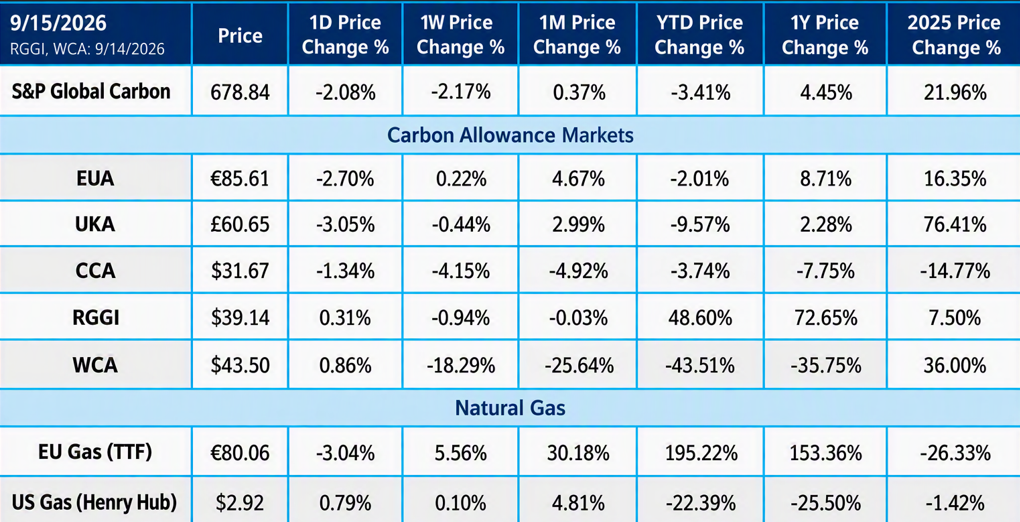
The S&P Global Carbon index declined over the week, down 2.17%. EUAs were broadly unchanged at €85.61, up 0.22% week over week, while UKAs slipped to £60.65, down 0.44%. In North America, CCA prices fell to $31.67, down 4.15% over the week, and RGGI allowances eased to $39.14, down 0.94%. WCA remained under pressure, ending at $43.50, down 18.29% over the period.
- Our estimate of the aggregate numbers here excludes the aviation and maritime sectors, but we would expect the same modest proportional increase in the cap for these sectors under the Parliament’s proposed amendments. As a result, if the Parliament’s initial proposal were ultimately accepted by the Commission and the EU Council, we estimate that the total EU-ETS cap over 2031-40 would be 1.3% higher than under the Commission’s blueprint.