
Highest CCA Auction Clear in Two Years, EUAs Remain Resilient Amid Rising Natural Gas Prices
4 Min. Read Time
California’s Q3-auction results were released yesterday (August 26) and showed a strong bounce from the Q2 auction, with all 49m current vintage allowances sold at $32.48/ton, up 13% on the May auction settlement of $28.81/t. This is the first time that the auction price has cleared above $30/t since the Q4-2024 auction and the highest settlement since May 2024. Meanwhile, the market awaits the approval of rulemaking package by the California’s Office of Administrative Law (OAL) in the next few days, which is expected to take effect September 1.
In Europe, EUAs have traded in a range of €81-84/t throughout August, the peak holiday period in the EU when trading activity is typically subdued. One thing no keep an eye on, though, is the recent strength in EU natural-gas prices, with the benchmark front-month price at the Title Transfer Facility (TTF) hub posting two-year highs in the last week. If TTF prices increase further as the market looks to winter storage levels, this could add political pressure to the negotiations over the EU-ETS Review when these begin in earnest in September.
CCA auction was strong but all eyes now on the OAL and the FSOR implementation date
The much higher clearing price in the Q3-CCA auction versus Q1 and Q2 reflects the progress made since the California Air Resources Board (CARB) Board meeting in late May approved the revised ISOR, thus enabling CARB to issue the final regulatory package, the Final Statement of Reasons (FSOR), with a view to implementation from September 1. In addition, the progress made on including Washington in the WCI program – as explained in our blog of June 30, the aim is to have linkage between California, Quebec, and Washington by Q4 2027 – has also helped with sentiment for CCAs given the greater tightness of the Washington program.
In addition to the higher clearing price, the auction's cover ratio was 1.31x, the highest since August 2025, while non-compliance entities took 22% of the allowances on offer, the highest level since all the way back in August 2021. This is a healthy sign of investor interest and bodes well for further price appreciation if CARB is able to implement the reform package from September 1 as it is still hoping.
As far as the implementation date is concerned, the ball is now firmly in the OAL’s court. The OAL was originally expected to publish its verdict by August 25, 30 days after the original submission date, but it announced on Friday August 21 that CARB’s FSOR was resubmitted on August 20.
Between the OAL update and confirmation later that day that the original September 1 timeline was unchanged, CCA briefly traded at $31 before rebounding. The OAL clarified after market close that the resubmission was procedural only in that the FSOR needs to be considered alongside the interrelated Mandatory Reporting of GHG Emissions Regulations (MRR). The OAL also stated in its clarification that it still plans to issue its opinion on both the Cap-and-Invest and MRR updated regulations by September 1, per CARB's request.
The Dec-26 contract has traded in a range of $32.5-$33/t all this week as the market awaits the outcome of the OAL’s deliberations. Should OAL validation of the FSOR be forthcoming ahead of the September 1 deadline that CARB is still aiming for then we think this would provide scope for further price appreciation through year-end. On the other hand, any further hold-ups either in the decision itself or a decision requiring a reworking of the FSOR such that the implementation date needs to be put back would be negative.
EUAs have held strong throughout August but TTF will now be key heading into winter
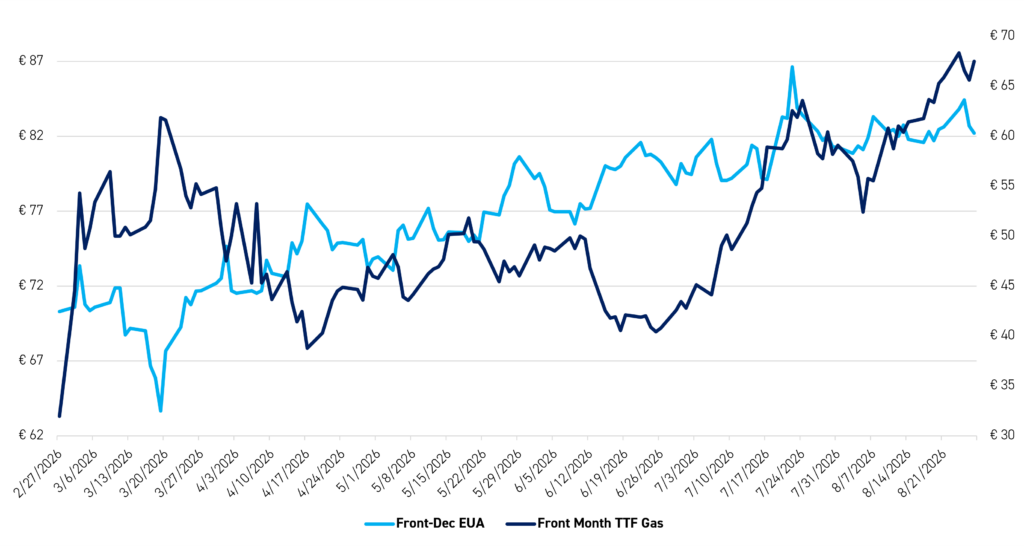
Figure 1 shows EUAs versus TTF since the beginning of the conflict with Iran in late February. As can clearly be seen, there has been a strong inverse correlation between the two over recent months (and indeed stretching back to the beginning of 2025), owing to the impact of high natural-gas prices on the competitiveness of EU industry and hence the political pressure this typically leads to on the EU-ETS from member states with concerns over their industrial base.
Figure 1: Front-Dec EUA (LHS, €/t) versus Front-Month TTF (RHS, €/MWh) Feb 27 – Aug 27, 2026
Source: Bloomberg
The impact of high TTF prices on EU industrial competitiveness is both direct and indirect in that i) they have a particularly negative impact on industries that use natural gas as a feedstock (e.g. the chemicals industry), and ii) they push up electricity prices for all industry as natural gas is the marginal price-setting fuel for most power markets across the EU.
As a result, when TTF prices move above the €60/MWh threshold we are into dangerous political territory for carbon, as while EU policy-makers can do little to influence natural-gas prices they can obviously exercise a much higher degree of influence over EU carbon prices (we have discussed this point several times in our blogs throughout this year, particularly in our post of March 16).
And with trilogue negotiations between the Commission, Council, and Parliament on the EU-ETS reform package about to get serious in September and into Q4, this could be a complicating factor: if TTF remains at current levels or pushes even higher as we approach winter on fears of low gas-storage levels then this could make for a difficult negotiation on the package, with some member states likely to flag industrial competitiveness as a major concern and hence something that should be addressed more directly in the Commission’s proposed reforms to the EU-ETS.
This means that the carbon market will be paying very close attention to TTF in the months ahead and that we should be on the alert for pronouncements on this topic from member-states and the EU parliament in the next couple of months.
Carbon Market Roundup
The weighted global price of carbon was $60.40, down 0.41% week over week. EUAs ended at €82.42, down 0.04% on the week, while UKAs closed at £59.00, up 0.05%. In North America, CCA prices closed at $33.24, down 0.63% over the week, and RGGI allowances were up 1.55% to $42.00. WCA ended down 1.97% at $57.35.