UK-EU Summit Date Boosts UKAs, CCAs Get Off to a Solid Start in Q4
6 Min. Read Time
After drifting lower against EUAs over the course of September, UKAs received a big boost in recent days from media reports that the UK and the EU will hold a summit on November 20 to finalize arrangements to link their respective carbon markets. Meanwhile, next week sees the first full EU Council meeting since the EU Commission published its EU-ETS Review proposals in July, and with member states broadly divided into three camps on the substance of the Commission’s proposals, this will be a key test of their ability to compromise with a view to finding a common position by the time of the next Council meeting in mid-December.
In North America, and after a weak September in which the benchmark Dec-26 contrast lost 3.5%, Q4 has begun more positively with CCAs up 2.5% at last night’s close of $32.76/t from the September 30 settlement of $31.96/t. In Quebec, the separatist Parti Québécois (PQ) topped the provincial election on October 5 with 59 seats, five short of a majority. Although the PQ did not specifically reference its cap-and-trade policy during the election, it remains progressive on climate policy, and we see no threat to Quebec’s cap-and-trade program or to Washington's plans to join California under the joint market known as the Western Climate Initiative (WCI) program in 2027.
UKAs narrow the discount to EUAs as UK-EU summit is now expected on November 20
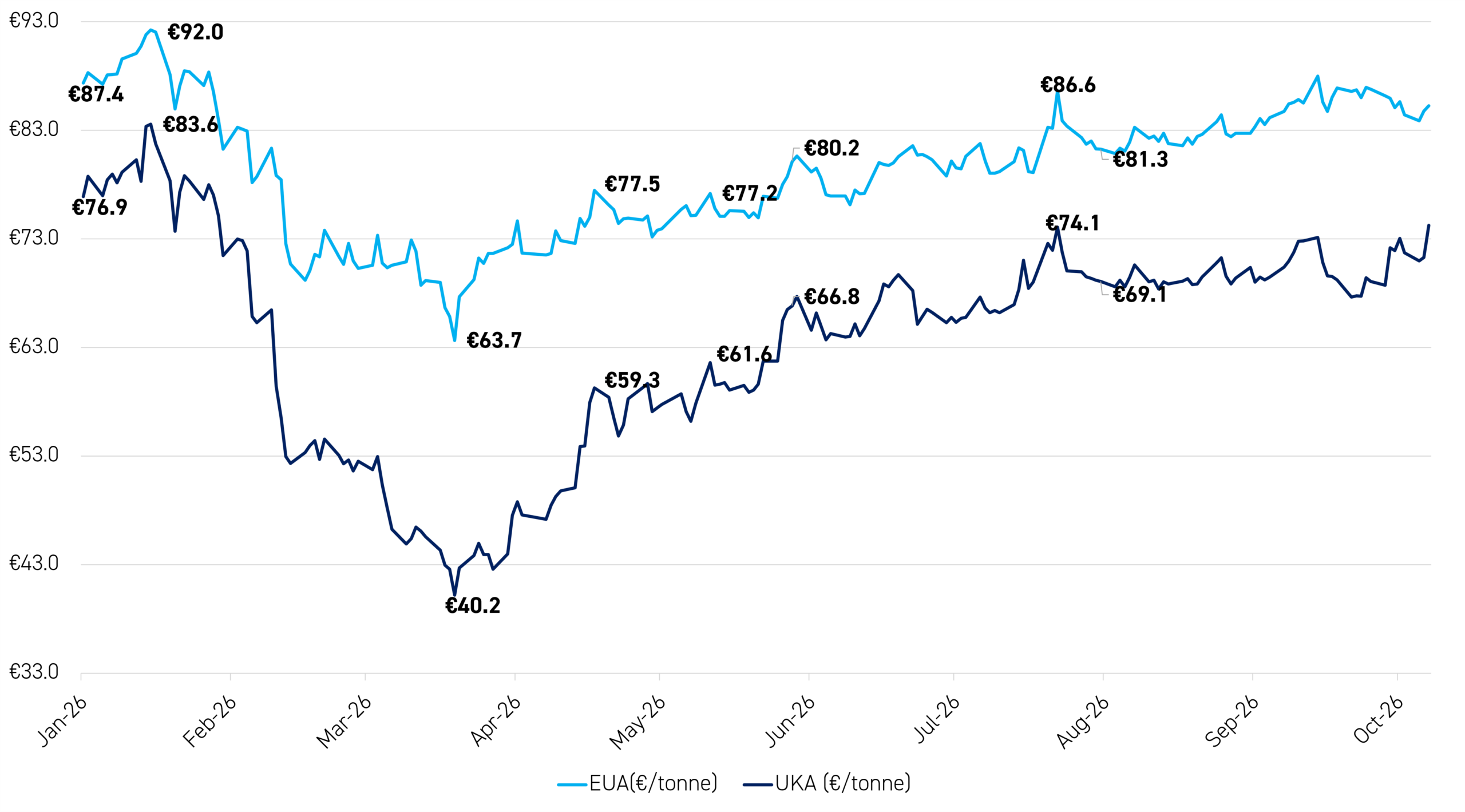
Figure 1 shows UKAs versus EUAs since the beginning of this year, and Figure 2 shows the spread between the two over the same period.
Figure 1: Dec-26 EUA versus Dec-26 UKA* contract January 1-October 7, 2026 (€/t)
Source: Bloomberg. *UKAs are here shown in €/t with their price adjusted at the prevailing £/€ exchange rate over time.
As can be seen in Figure 1, the two have been very closely correlated since the beginning of the year, with UKAs tracking EUAs with a greater or lesser discount over the last nine months, depending on the market’s perception of the political temperature around linking.
As shown in Figure 2, at the narrowest point, in January, the UKA discount was only €8.50/t, while at the widest point, in early April, it blew all the way out to €29/t.
Figure 2: Dec-26 UKA discount* to Dec-26 EUA, January 1-October 7, 2026 (€/t)
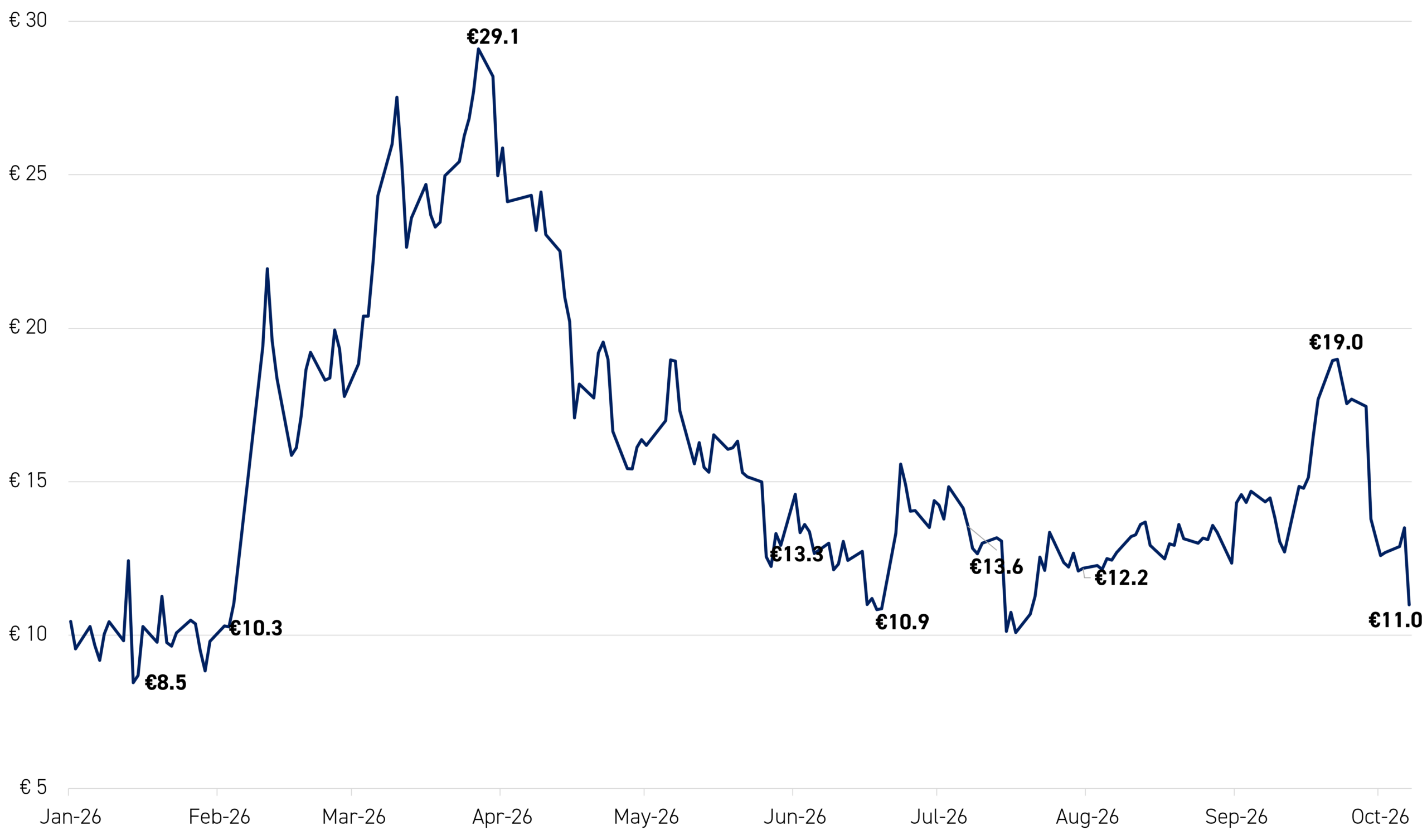
Source: Bloomberg. *The discount is shown in €/t with UKAs adjusted at the prevailing £/€ exchange rate over time.
The volatility in the spread over the course of this year mainly reflects the political volatility the UK has gone through, with speculation over Keir Starmer’s premiership building steadily from February and intensifying after poor election results in May. Andy Burnham replaced Starmer as UK Prime Minister on July 20, and on that day, the spread was back at only €10.7/t as relief over the arrival of a new PM with stronger political instincts gave the market hope that the UK would now experience greater political stability.
However, soon after assuming office, Burnham postponed the long-awaited UK-EU summit, which pushed the UK-EUA spread wider again, reaching €19/t as recently as September 20. In the last 10 days, though, press reports have stated that the summit is now set for November 20, and that a deal on linking has essentially already been reached, bringing the spread all the way back down to €11/t. According to a report in the Financial Times on September 30:
“The UK and the EU have agreed the outline of a deal ahead of the summit, including a youth experience scheme, the removal of trade barriers for food products, and the linking of emissions-trading schemes.”
This report prompted a €5/t drop in the spread last week, and as reported on Wednesday by Carbon Pulse another media article published three days ago by Politico reinforced the original FT report by quoting a senior EU diplomat as saying that the deal on linking was now done and that the two parties are now “tying a ribbon” on the agreement ahead of the expected announcement on November 20.
Our base case throughout the year has been that a formal deal on linking would be announced at some point this year with a view to operationalizing the link by April 2028, at which point EUAs and UKAs will become fully fungible instruments. We therefore expect the UKA discount to EUAs to narrow further over the next few weeks in the run-up to the November 20 summit.
Meanwhile, there are two important political meetings in Brussels next week that will provide key pointers as to how EU member states are thinking about the EU-ETS Review.
First, on October 12, we have a meeting of the EU member-state Environment ministers. Then on October 15-16 a meeting of the EU Council, bringing together all the heads of government of all 27 member states. These will be key markers on the road to achieving agreement on a common position amongst member states for the negotiations with the Parliament and Commission starting in January. Ireland currently holds the EU Presidency and wants to reach a common position – or what is known in the EU jargon as a ‘general approach – between all member states at the EU Council meeting on December 17-18.
What makes this so complicated is that there are three different groups of countries when it comes to the positions likely to be staked out next week (this classification covers 19 of the 27 member states).
First, there are the so-called high-ambition countries, comprising Denmark, Finland, Luxembourg, the Netherlands, Portugal, Spain, and Sweden. We think these countries will likely call for: i) higher Linear Reduction Factors (LRFs) over 2031-35 and 2036-40 than the 3.7% and 1.7%, respectively, proposed by the Commission; ii) the non-inclusion of international credits; and iii) maintaining the conditionality on free allocation from 2031, proposed by the Commission.
Second, there are the so-called low-ambition countries, comprising Bulgaria, Cyprus, Czechia, Estonia, Greece, Hungary, Italy, Poland, Romania, and Slovakia (Austria and Croatia are not formally aligned with these countries but are known to share many of their concerns). We think these countries will likely argue for: i) lower post-2030 LRFs than those put forward by the Commission (especially over 2031-35) while retaining the proposal on international credits; ii) the rejection of conditionality on free allocation; iii) call for the suspension of CBAM phase-in until its effectiveness at curtailing carbon leakage can be proven; and iv) propose amendments to Article 29a to offer greater flexibility for limiting EUA price spikes. The watchword for these countries is competitiveness rather than climate.
Third, there is France and Germany. We think that the two largest EU countries will likely agree with some elements of the high-ambition countries’ positions (for example, on excluding the use of international credits), while also supporting some aspects of the low-ambition countries' agenda (for example, softer LRFs beyond 2030, although not as soft as what the low-ambition countries are aiming for).
Overall, given that France and Germany are both very concerned about industrial competitiveness, and given that the low-ambition countries between them have a blocking minority, we expect next week to move member states towards agreeing a general approach in December that suggests a modest dilution of the Commission’s proposals in certain key areas (LRFs, conditionality of free allocation) while possibly yielding to the high-ambition countries on the issue of international credits. We will know more by the end of next week.
CCAs off to a good start in Q4, Quebec elections return Separatists but WCI linking on track
After a weak September in which the benchmark Dec-26 CCA contrast lost 3.5%, Q4 has begun more positively with CCAs up 2.5% at last night’s close of $32.76/t from the September 30 settlement of $31.96/t.
We think that September's price movement was driven by technical factors (e.g., end-of-quarter reporting, options expiry, and profit-taking), and have not changed our view on the fundamentals. Accordingly, we continue to think that anticipation of the tightening in CCA supply in 2027, together with progress on linkage with Washington, will give CCAs a tailwind through year-end and push prices up to $35/t.
In Quebec, the separatist Parti Québécois (PQ) topped Quebec's provincial election on October 5 with 59 seats, five short of a majority. The Quebec Liberal Party (PLQ) was second with 40 seats and will serve as the official opposition in Quebec's National Assembly.
Although the PQ did not specifically reference the WCI Cap-and-Trade program during the election, it remains progressive on climate policy. We expect it to work with the smaller party Québec Solidaire (QS), which supports maintaining a GHG reduction target of 37.5% by 2030 versus 1990 and reaching carbon neutrality by 2050. In our view, a PQ-QS alliance on environmental policy will likely support Quebec’s participation in the WCI program, including the plan – already underway – to have Washington join the program.
Quebec also published its 2025 verified emissions earlier this week, which came in at 57.2Mt. This represented a 0.3% increase versus 2024 and was slightly below our expectations, although this was the eighth year in a row that emissions came in below the cap. California will report its 2024 emissions on November 4.
Carbon Market Roundup
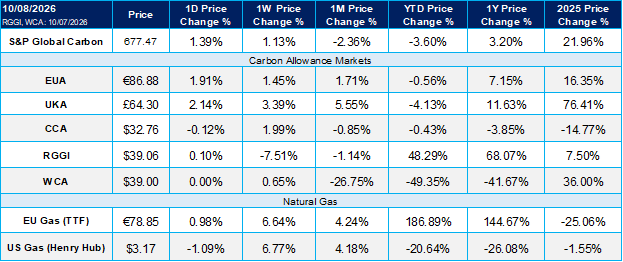
The S&P Global Carbon index was up 1.13% over the last week. EUAs ended at €86.88, gaining 1.45%, while UKAs climbed to £64.30, up 3.39%. In North America, CCA prices increased to $32.76, up 1.99%, while RGGI allowances fell to $39.06, down 7.51%. WCA edged higher to $39.00, up 0.65% over the period.