
Washington State Signs Agreement to Link with California’s Market, EU-UK Summit Postponed
4 Min. Read Time
On June 25, California and Quebec signed an agreement with Washington state to start the process of linking their emissions-trading systems, thereby opening the way for the Evergreen State to join the Western Climate Initiative (WCI). Washington carbon allowances (WCAs) had already been softening in the run-up to the announcement, as once linkage is operational at some point next year, compliance entities in the much tighter Washington market will be able to draw on CCAs and Quebec carbon credits to meet their obligations. The real story, though, is that adding Washington’s tighter balances to the WCI is structurally supportive for CCAs at the margin going forward.
In Europe, the EU/UK summit originally scheduled for July 22 has been postponed to an unspecified later date to allow the new UK Prime Minister – expected to be in post by July 20 – to settle into office first. However, we do not view this as a risk to the timeline for linking the UK-ETS with the EU-ETS, and while the initial market reaction to this news was a €5/t blow-out in the EUA/UKA spread, the UKA discount to EUAs has narrowed back somewhat since, and at €13.3/t is now trading in the middle of the last month’s range.
The aim is for Washington to join the WCI in 2027: ambitious but achievable
On June 25, California, Quebec, and Washington signed an agreement in Seattle to begin the formal process of linking the Washington market to the WCI. With Washington having already amended its Cap-and-Invest regulations to prepare for linkage, the timeframe for formally enabling Washington to join the WCI will depend on the speed with which California and Quebec can make the necessary regulatory accommodations on their side. The press release published by Washington states that the plan is to have the three markets linked at some point in 2027:
“While completing a linkage agreement is a major milestone, it is just one part of each jurisdiction’s linkage process. In Washington, the Climate Commitment Act establishes that the linkage agreement is the step that authorizes Washington’s Cap-and-Invest Program to accept allowances and offset credits from California and Québec, completing the linkage process. California and Québec must complete additional steps, including adopting regulations to accept compliance instruments from Washington, before a linked market can take effect. Officials expect to operate a linked market in 2027.”
The 2027 target date is also referenced in the press releases issued by both the Californian market regulator, CARB, and the Quebec Ministry for the Environment, indicating that the will to expedite the linkage process seems to be present in both jurisdictions. However, while we expect California and Quebec to begin amending their regulations later this year, there is a complication in that both jurisdictions will undergo political transitions to new administrations later in 2026. That said, we would expect the incoming administrations in both California and Quebec to be supportive of linkage, so the 2027 timeframe for operationalizing linkage should still be achievable.
If the link is indeed operationally formalized before November 2027, Washington compliance entities will be able to use CCAs and Quebec-issued allowances for compliance against the state's first compliance period (CP1) obligations (the deadline for CP1 is November 1, 2027), thereby reducing the need to rely on Washington’s Allowance Price Containment Reserve (APCR). For context, the APCR serves as a market-stability mechanism that releases additional allowances from a reserve pool at predetermined trigger prices ("tiers") when allowance prices rise too quickly, designed like speed bumps to reduce price volatility.
The current price differential between CCAs and Washington’s APCR Tier-1 is substantial, with the Dec-26 CCA contract having settled yesterday at $33.03/t compared with a WCA APCR Tier-1 2026 price of $65.26/t, and a WCA Dec-26 closing price yesterday of $53/t.
As a result, linking Washington to the WCI will bring WCAs down towards CCA and Quebec price levels while also raising CCAs and Quebec prices somewhat, owing to the extra demand that Washington compliance entities will bring to the WCI Program.
Indeed, with the tighter balances that Washington will bring to the WCI over the medium to longer term, we would expect the cumulative allowance bank to deplete one year earlier than we are currently modeling – 2032 instead of 2033 – once the Evergreen State is incorporated.
UK political turmoil forces postponement of EU/UK summit but linking still on track for 2028
On June 22, UK Prime Minister Keir Starmer announced his resignation as the leader of the Labor Party, clearing the way for a leadership contest or, in the absence of a contest, the ‘coronation’ of Andy Burnham as new Labor leader and therefore new UK Prime Minister. So far, Burnham is the only declared candidate, and if nobody else puts his or her name forward before the filing deadline of July 16, then Burnham will become Labor leader on July 17 and then replace Starmer as UK Prime Minister on July 20. We think it highly unlikely that anybody else will run against Burnham, and hence think it overwhelmingly probable that Andy Burnham will become Prime Minister in three weeks’ time.
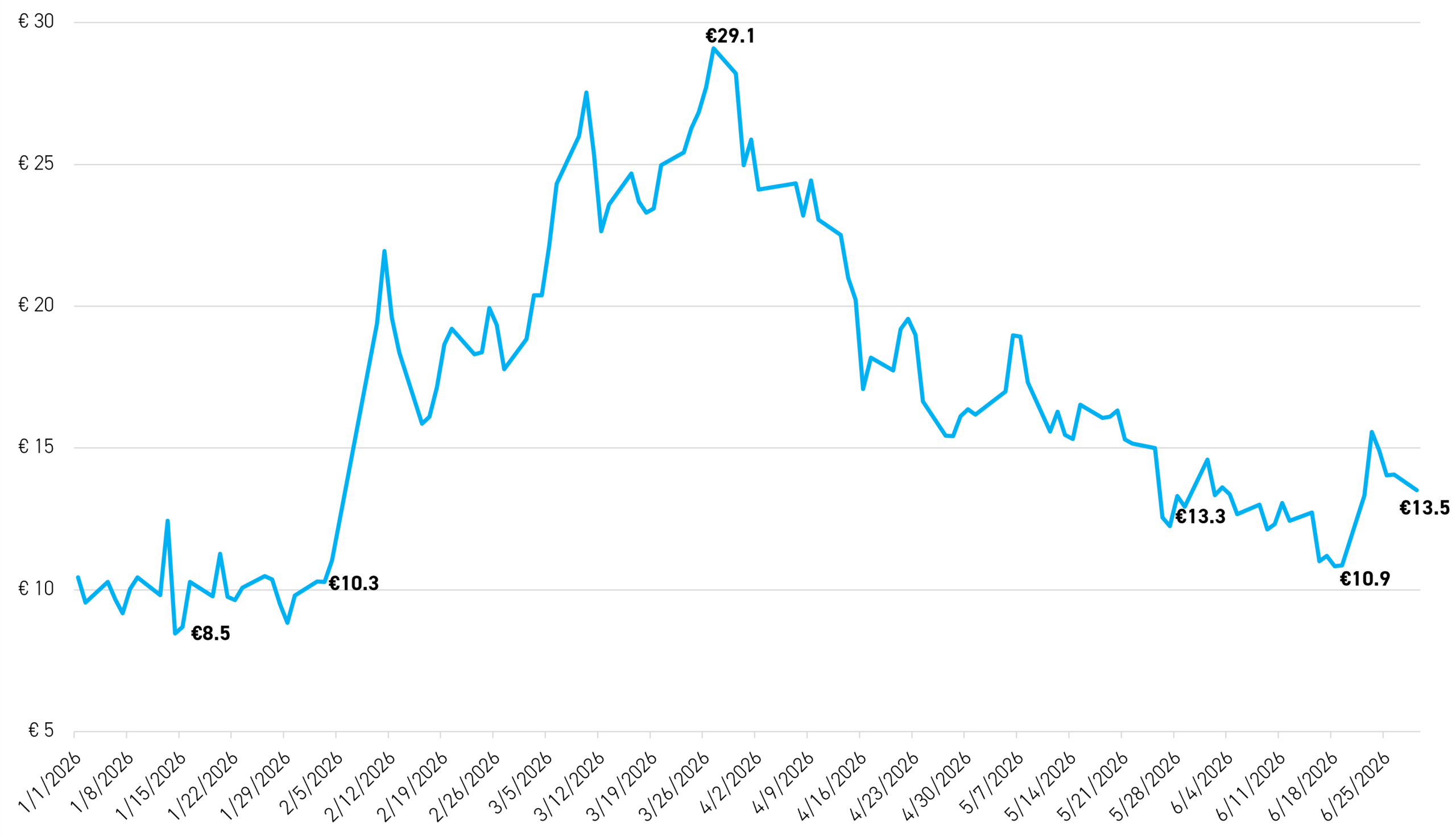
The news of Starmer’s resignation was not a surprise as the pressure had been building for months after Labor’s declining poll ratings and disastrous local-election results in May. However, what did come as a surprise was the decision of Antonio Costa, the President of the EU Council, to postpone the EU/UK summit scheduled for July 22 until a new PM has had time to settle. UKAs sold off sharply on the day of this news, dropping 2.6% and thereby causing the discount to EUAs to widen by €2.4/t, to €13.3/t from the four-month low of €10.3/t on June 19. The discount then widened further on June 23 to €15.6/t before dropping back to €13.3/t at yesterday’s close (Figure 1).
Figure 1: Dec-26 UKA discount to Dec-26 EUA contract, January 1 — June 29, 2026 (€/tonne)
Source: Bloomberg. *Note that we have converted UKA prices into €/tonne here for ease of comparison.
In our view, Andy Burnham will likely be equally if not more pro-European than Starmer, and we therefore see no threat to the current UK government’s declared policy aim of linking the UK-ETS to the EU-ETS. Accordingly, we assume the EU-UK summit will be rescheduled for late summer and would still expect the two markets to formally operationalize their linkage by April 2028. We would therefore expect the EUA/UKA spread to narrow again over the next couple of months and, at some point, fall below the YTD low of €8.5/t recorded on January 14.
Carbon Market Roundup
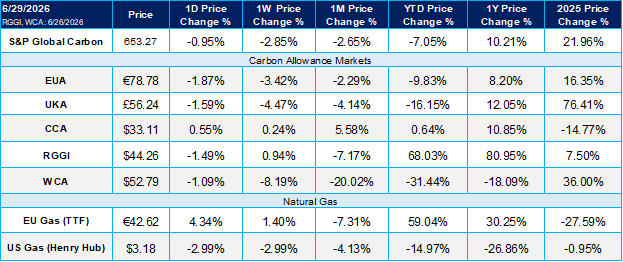
The weighted global price of carbon closed at $57.76, down 2.85% over the week. EUAs slipped to €78.78, down 3.42% on the week, while UKAs fell to £56.24, down 4.47%. In North America, CCA prices edged up to $33.11, gaining 0.24%, while RGGI allowances rose to $44.26, up 0.94%. WCA closed at $52.79, down 8.19% over the period.