
EUAs Higher Despite Nat Gas Risk, Our Updated RGGI Balances Now Tighter Through 2030
By Mark Lewis & Climate Finance Partners LLC (CLIFI)
6 Min. Read Time
We view the current set-up on EUAs as a battle between the fundamental tightness in the supply/demand balances on the one hand (bullish), and the rising political risks on the other (bearish). In this later respect, the violent spike in European natural-gas prices at the Title Transfer Facility (TTF) hub in the Netherlands over the last month is coming at the worst possible time as the negotiations over the European Commission’s EU-ETS reform package ramp up through the end of the year. Yesterday, TTF traded above €100/MWh for the first time since December 2022, and this will exacerbate the difficulty of reaching a common position in the EU Council on December 17-18.
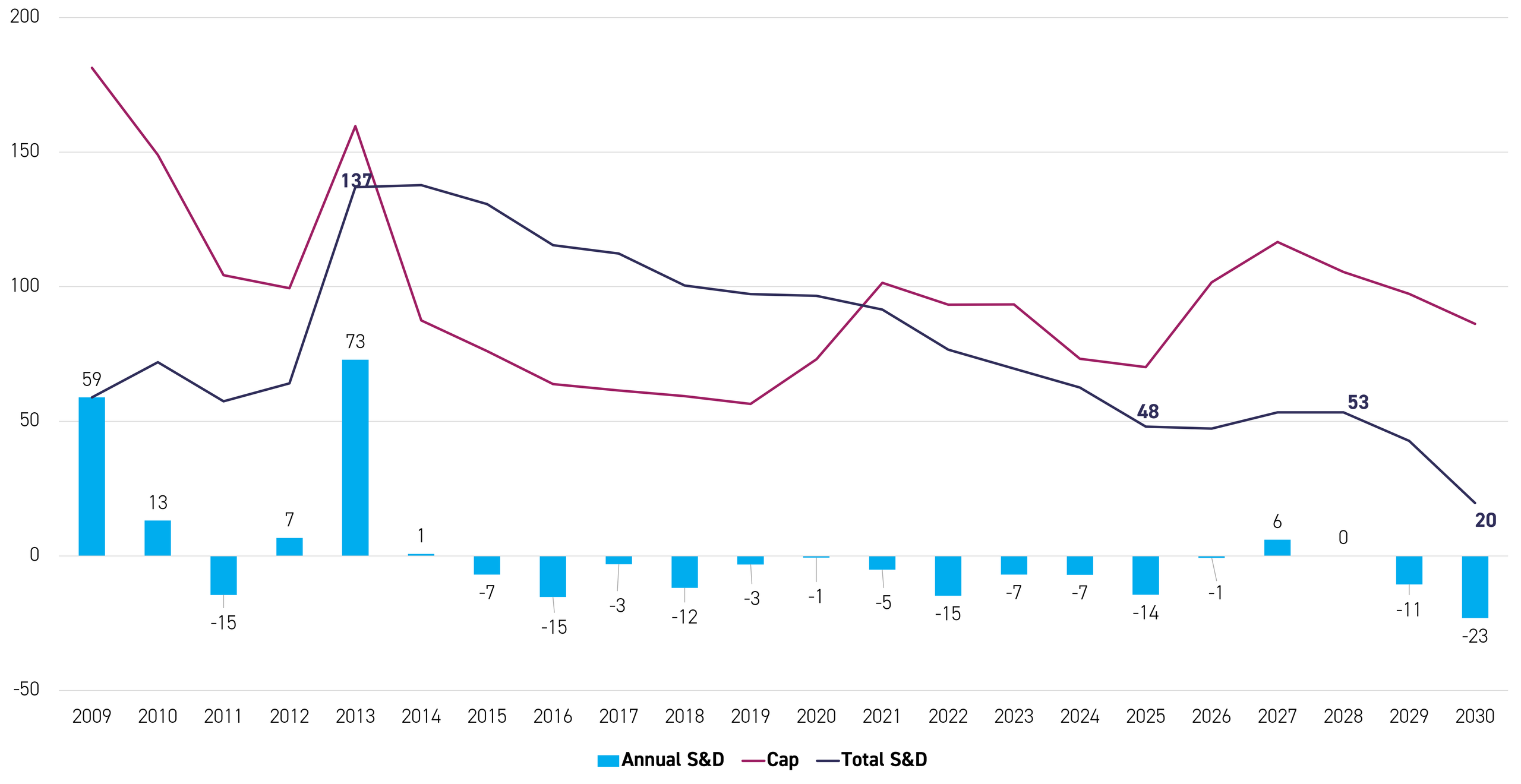
On US markets, we have updated our RGGI balances through 2030 and beyond to take account of Virginia’s re-accession to the scheme and of the so-called New Model 2025 Cap. Virginia’s own balances through 2030 are tight, and with all RGGI states in the process of aligning with the New Model Rule we now see the accumulated Bank of allowances falling to 20m short tons by the end of 2030 versus 35m previously. Beyond 2030, and under the existing supply trajectory, the market would get extremely tight very quickly but we expect RGGI’s Fourth Program Review – due to begin in 2028 – to increase supply over 2031-37 in order to avoid a violent spike in prices beyond 2030.
EUAs hit a nine-month high despite TTF trading through €100/MWh yesterday
In our last Climate Market Now blog of October 21, we highlighted how our updated EU-ETS supply/demand balances through 2030 indicate an even tighter market than our previous forecast, while also emphasizing the growing political risks around the EU-ETS reform package. Since the outbreak of hostilities with Iran in late February, we have also consistently highlighted the political risk to EUAs posed by high TTF prices. What we currently face, therefore, is a perfect storm, whereby the most important structural reform of the EU carbon market in five years is happening against the backdrop of the highest EU natural-gas prices in nearly four years. The front-month TTF contract is now up 250% year-to-date while EUAs are essentially back to flat versus January 1.
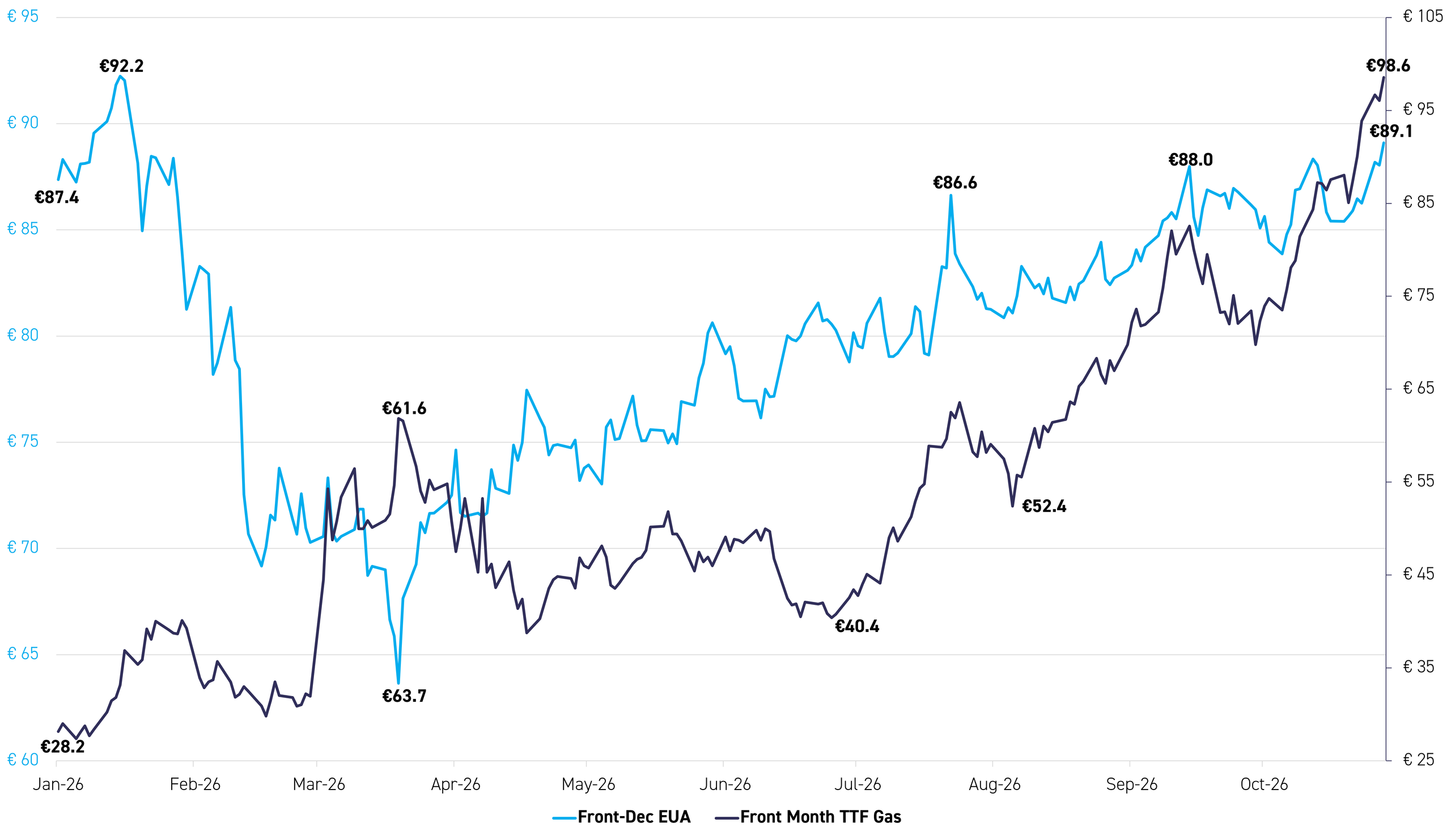
Figure 1 shows the correlation between EUAs and TTF since the beginning of the year.
Figure 1: Dec-26 EUAs (€/t, LHS) v. front-month TTF (€/MWh, RHS), January 1-October 28, 2026
Source: Bloomberg
As can be seen, EUAs and TTF were inversely correlated from January through June, reflecting the decline of the so-called fuel-switching price as a proxy for EUAs (a function of lower hedging volumes in the power sector), and the emergence of TTF prices as a barometer for the degree of political pressure that is brought to bear on the EU-ETS whenever TTF prices go above €50/MWh.
The inverse correlation held over the first half of the year but, paradoxically, once TTF moved above €60/MWh in late July EUAs followed the same upward price trajectory. This was because with TTF above €60/MWh power generators maximize coal burn across the EU, thereby creating higher short-term demand for EUAs. However, with coal burn now fully maxed out and TTF prices having traded up to €100/MWh in recent days, we think there is now a clear risk for EUAs that the question of industrial competitiveness will come forcefully back into the political conversation just as the EU Council and Parliament are trying to agree their respective negotiating positions on the EU-ETS reform.
This is because high TTF prices have both a direct and indirect impact on the cost-base of EU industry, with natural gas a key feedstock for the chemicals and fertilizer sectors (and by extension for EU agriculture), and also the marginal price-setting fuel for electricity across most of the EU. As a result, should TTF hold at or around €100/MWh as the European winter starts in earnest, we would expect EUAs to come off as speculators pre-empt this political risk by reducing their positions.
The good news, though, is that speculative positioning in EUAs is much lower than it was in January, when the net length of investors reached an all-time high (ATH) of 126Mt. As of the week ending October 23 the net-long position of investment funds was only 36Mt, having trended down gradually over the course of Q3 from 62Mt at the end of Q2.
In short, EUAs have had a very solid start to Q4, and yesterday’s high of €89.31/t was their highest intra-day print since January 16. On a fundamental basis the balances look extremely tight for 2026 and 2027, and for the time being the higher energy complex in the EU – that is to say, TTF and German power – is dragging EUAs up with it. Nonetheless, there is a growing and alarming tension between fundamentals and politics: the politics of the EU-ETS Review negotiations are heating up, with no sign yet of common ground emerging between the high-ambition and low-ambition countries in the EU Council, while TTF remains the supreme wild card in the mix.
Against this backdrop, we think the €90/t level is a flashing red light in the near term that could trigger negative political headlines and hence a correction in EUAs (as happened in February), albeit with strong fundamentals underpinning prices in the €75-80/t range.
Our RGGI balances through 2030 are now more bullish
On July 1 Virginia returned to the RGGI scheme, helping the Q3 auction held on September 9 to clear at $37.65/short ton (st), a new all-time high, and $2.65 from the previous record of $35/st at the Q2 auction. This was Virginia's first participation since its return to RGGI after having left the program in 2023. Then, on September 24, Virginia’s Department of Environmental Quality (DEQ) announced it had finalized Old Dominion’s RGGI regulations for the 2027–2037 compliance years. Virginia will directly adopt RGGI’s Model Rule 2025, and its cap will decline from 20.4 million allowances in 2027 to 2.2 million by 2037.
Importantly, Virginia’s unamended adoption of Model Rule 2025 means that the state will not be rebasing its cap in line with expected higher future emissions, nor introducing any other measures at this stage to smooth its re-accession to RGGI. This means that any changes to the program’s overall cap and/or its price-containment trajectory will now have to come via the next Program Review (due no later than 2028). The DEQ published the RGGI regulations in the Virginia Register of Regulations on October 19. Moreover, RGGI Inc. does not seem to be planning any further intervention in 2026. On October 6 RGGI Inc. published its auction notice for the Q4 auction due on December 2, announcing that no further RGA allowances will be set aside for the auction pool beyond the 2.2m extra announced on September 11.
Against this backdrop, Figure 2 shows our updated S/D balances for the RGGI scheme through 2030.1
Figure 2: Updated CLIFI base-case scenario for supply-demand balances for RGGI (m short tons)
Source: CLIFI, Clear Blue Markets
All 11 RGGI states, including Virginia, have either now adopted or are in the process of adopting new cap trajectories through 2037 to take effect from January 1, 2027 so as to align with the outcome of the Third Program Review, and these new state trajectories will form the so-called Model Rule 2025 Cap for the 11 states collectively. Under the Model Rule 2025 trajectory, the cap falls by 11m short tons per year over 2027-33, and then by 3.1m short tons per year over 2034-37.
This is a much higher rate of decline than under the previous trajectory, which mandated an annual drop in the cap of only 2.8m short tons per year over the entire 2027-37 period. Moreover, the New Model Rule also allows the RGGI program to operate beyond 2037, though caps beyond 2037 are currently set flat at the 2037 level, with post-2037 trajectories to be determined under the Fourth Program Review, which is due to begin in 2028.
However, cognizant of the upward price pressure that such a precipitous rate of decline would risk having, RGGI regulators have introduced significant extra supply through 2030 in the form of materially higher Cost Containment Reserves (CCRs), including the addition of a second CCR tier. Starting in 2027, the RGGI program will have 30.4m allowances per year available in the two reserves, shared equally between 15.2m in the Tier-1 CCR (of which 3.4m are contributed by Virginia), and 15.2m in the Tier-2 CCR (again, of which 3.4m from Virginia).
Paradoxically, this means that if all Tier-1 and Tier-2 CCR volumes were ultimately triggered, total supply over 2027-30 compliance years would in fact be greater than under the previous regulations. This reflects the importance RGGI regulators attach to keeping RGA prices in check over the short term after the dramatic upward trajectory in RGA prices since 2024. However, given the size of the existing Bank and hence the limited need of compliance entities to bid over-aggressively in auctions over 2027-28, we do not think the full annual CCR supply of 30.2m will be triggered until 2029.
This means that beyond the true-up for the current compliance period in March 2027, a correction in RGA prices is likely as in 2027 and 2028 prices will likely track close to the Tier-2 CCR level ($29.25 and $31.3 respectively), before trending higher again from 2029 as the Bank starts to draw aggressively.
In the short term, though, with no further allowances being made available for the Q4 auction, both the Q4 auction and the secondary market should remain underpinned by robust compliance demand through year-end as covered entities look to cover their compliance shortfall. We therefore expect the market to remain around current levels or even trend slightly higher through the forthcoming compliance deadline in March 2027.
- We will publish a second piece on our updated RGGI modelling to cover our revised forecasts over the period 2031-37 in our next Climate Market Now blogpost.