Carbon Markets Enter Election Season, Updated EU-ETS Model More Constructive
By Mark Lewis & Climate Finance Partners LLC (CLIFI)
7 Min. Read Time
We have updated our EU Emissions Trading System (ETS) supply/demand (S/D) balances through 2030, and the market looks tighter than our previous numbers. We now see a total drawdown in the cumulative surplus of 397Mt over 2026-30 compared with 323Mt previously, with the accumulated bank of allowances – the Total Number of Allowances in Circulation (TNAC) in EU jargon – falling to 448Mt European Union allowances (EUAs) by 2030 versus 517Mt previously. Against that, however, we see rising political risk in Spain and France with general and presidential elections ahead in late November and April/May, respectively. The outcome of these elections could complicate both the substance and timing of reaching a common negotiating position in the EU Council.
In the US, California carbon allowances (CCAs) and the Regional Greenhouse Gas Initiative allowances (RGAs) traded in a narrow range while Washington state carbon allowances (WCAs) continue to drift closer to CCA price levels. However, with the latest inflation readings pointing to a Consumer Price Index (CPI) uplift of 3.7% on top of the fixed 5% CCA auction reserve (floor) price escalator, we think CCAs can still rally towards $35/t through year-end, with the US midterm elections and the Q4 auctions the main potential event risks to this scenario.
Our Updated EU-ETS Balances Through 2030 Are Now More Constructive
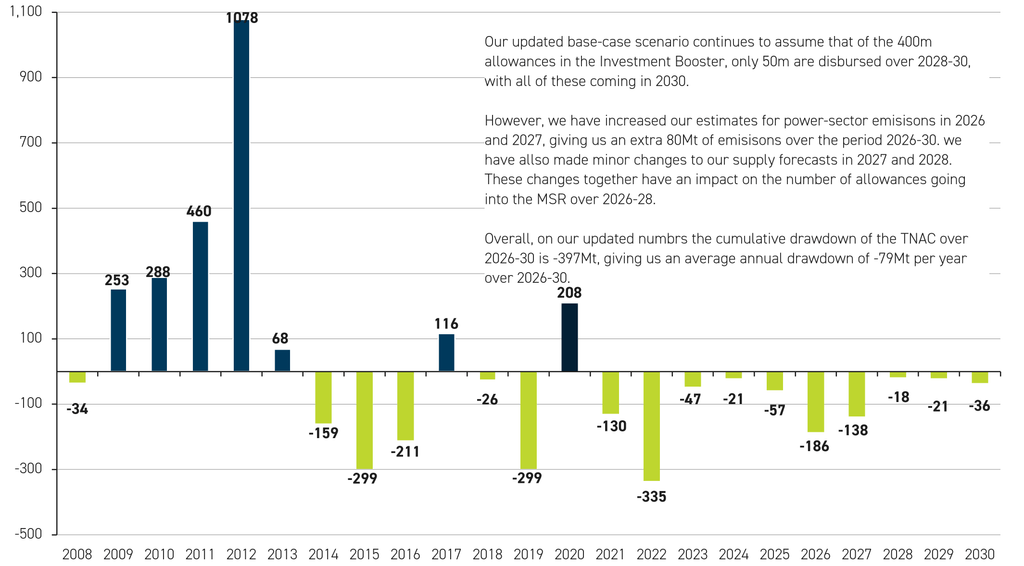
Figure 1 shows our updated S/D balances for the EU-ETS through 2030. We have increased our forecast for power-sector emissions over 2026-30 (mainly over 2026-28) to account for higher coal-fired generation. The impact of sustained high EU natural-gas prices at the benchmark Title Transfer Facility (TTF) hub means power generators are running coal ahead of gas everywhere there is a choice between the two fuels, and we now expect TTF prices to remain elevated through the next 18 months.
Figure 1: CLIFI updated base-case EU-ETS S/D balances,* 2026-30 (Mt)
Source: CLIFI. *Including Aviation and Maritime emissions.
Our revised balances now project a cumulative deficit over 2026-30 of -397Mt (versus -323m previously), resulting in an average annual drawdown of -79Mt over this period, with the total system-wide bank of allowances (the TNAC) falling to 458Mt by the end of 2030 (versus 517Mt previously).
Our projected deficits for 2026 and 2027 are higher by 50Mt and 59Mt respectively, but our updated auction forecasts project slightly less supply in 2027 but more in 2028, such that our projected 2028 deficit is 33Mt lower than previously. Our balances for 2029 and 2030 are unchanged, meaning we continue to see consecutive annual deficits through 2030.
Figure 2 shows our updated forecast for the system-wide TNAC, i.e., including Maritime and Aviation emissions, through to 2030.
Figure 2: CLIFI updated base-case cumulative system-wide* EU-ETS surplus (TNAC), 2008-30 (Mt)
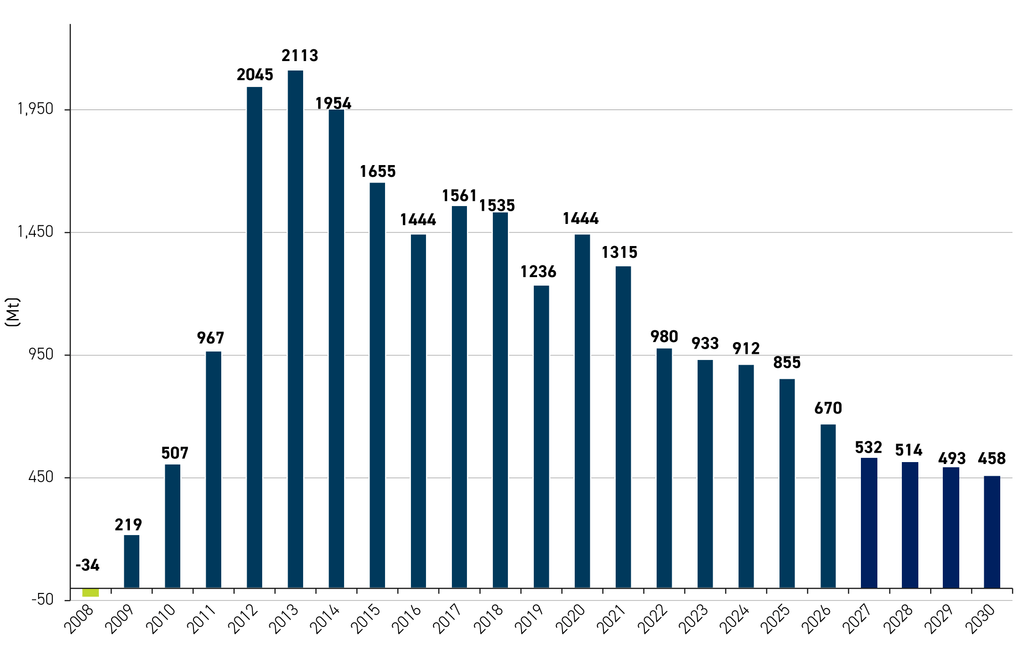
Source: CLIFI. *This number represents the TNAC number published by the European Commission every year, adjusted to include the cumulative Aviation deficit from 2012, not just from 2024. This explains why this system-wide cumulative-surplus number is materially lower than the TNAC number as published by the European Commission for the years prior to 2027. However, starting from the 2027 TNAC number to be published in May 2028, the Commission’s TNAC calculation will be revised to include the cumulative Aviation deficit over 2012-23, such that from 2027 onwards the Commission’s TNAC calculation will be consistent with the one we have always used to gauge the true level of outstanding EUA inventory.
Taken on their own, our updated balances are constructive for EUAs over the near term, as tighter balances through year-end 2027 should provide strong support for EUAs around current levels. However, while the numbers look bullish, the political headwinds around the EU-ETS Reform process are likely to get stronger over the next six months as the second and fourth-largest EU member states – France and Spain – face general elections and likely changes of government.
Political Headwinds: Spanish Elections Now a Key Risk Ahead of Next EU Council Meeting
After the EU Council meeting of October 11-12 failed to produce meaningful progress towards agreeing a common negotiating position of all member states ahead of the formal trilogue discussions with the EU Parliament and EU Commission expected in Q1-2027, the market now has a new political event risk to worry about: an early general election in Spain scheduled for November 29.
As we explained in our last Climate Market Now blog (October 9), the current Irish presidency of the EU wants to agree a common position – known in the EU jargon as a ‘general approach’ – at the EU Council meeting on December 17-18. However, this was always an ambitious target given the sharp divisions between the so-called high-ambition countries (Denmark, Finland, Luxembourg, the Netherlands, Portugal, Spain, and Sweden) on the one hand, and the low-ambition countries (Bulgaria, Cyprus, Czechia, Estonia, Greece, Hungary, Italy, Poland, Romania, and Slovakia) on the other (France and Germany are not formally aligned with either of these groups).
With reports of tension between the high-ambition and low-ambition groups at the recent Council meeting 10 days ago underlining how hard it will be to arrive at a general approach by mid-December, we now have a Spanish general election thrown into the mix. On October 5, the Spanish Prime Minister, Pedro Sánchez, called an early election in an attempt to gain political capital out of the housing crisis, which has become a key cause for mobilizing his left-wing base. However, opinion polls have consistently put his ruling Socialist party (PSOE) behind the center-right (Partido Popular, or PP) and far-right (Vox) parties. Politico’s most recent poll of polls has the PP at 32% and Vox at 19%. Their combined 51% is way ahead of the PSOE on 26%, and the broader left and nationalist parties with whom Sánchez has been in coalition for the last three years are also now very fragmented, meaning that the odds-on favorite to win the election and govern for the next four years is a PP/Vox coalition.
The issue as far as the EU-ETS is concerned is that given the views of the PP and Vox, such an outcome would flip Spain from the high-ambition camp to the low-ambition camp, in turn reinforcing the strength of the blocking minority already enjoyed by the low-ambition group of countries. This would make it harder for the high-ambition group to strengthen the Commission’s EU-ETS proposals and hence likelier that the general approach ultimately reached in Council might dilute the Commission’s reform package more meaningfully than would otherwise be the case. And although the new government will not be able to take up power until the new Parliament is officially constituted on December 23, if the PP and Vox win a decisive victory on November 29, this will make Sánchez a lame duck at the EU Council meeting on December 17-18, and hence make it hard, if not impossible, for him to continue arguing for a high-ambition general approach.
Beyond that, we have the French presidential elections, with the first round on April 18 and the second round on May 2. Polling over the course of this year has consistently put the far-right candidate and leader of the Rassemblement National (RN) Party, Marine Le Pen, in the lead for the first round, with an average of 34% of the vote, way above the 17% of the second-placed candidate. This makes her the clear favorite to be elected President in the subsequent run-off on May 2. The significance of this is that the RN has consistently argued against the EU’s climate policies, and would without doubt move France into formal membership of the low-ambition EU-ETS Reform group.
This means that much will depend on whether a general approach can be agreed at the Council meeting on December 17-18, or at the next Council meeting after that in late March 2027 (under the Presidency of Lithuania), as the longer it takes to find a general approach, the greater the risk that by the time the Council can find agreement, France’s middle-of-the-road position will have flipped to low ambition. In short, the political risk is rising on EU-ETS Reform, and the next key date to watch is Spain’s election on November 29.
US Carbon Markets: Midterm Elections and Q4 Auctions in Focus
The US midterm elections on November 3 are now front and center, with the latest Real Clear Politics (RCP) generic congressional polling giving Democrats an eight-point lead over Republicans, at 50.4% and 42.1%, respectively. With 10 days to go, the RCP House map, based on current polling, has the Democrats likely to win 226 seats and the Republicans 187, with 22 toss-ups, while the RCP Senate map shows both parties at 46 Senate seats, with 8 toss-ups.
We do not think the midterm results will have a direct impact on US markets from a fundamental standpoint, but there could be a sentiment effect depending on which party comes out on top. A Democratic clean sweep of the House and Senate would likely be a positive boost to sentiment, as it might help ease concerns over a potential federal legal challenge to the state cap-and-invest programs, whereas if the Republicans do better than expected, and in particular if they retain the Senate, this will likely be a sentiment boost for President Trump and his anti-climate agenda.
In terms of market news, CCAs remain in their tight trading range, closing at $32.75/t last night, up 1.5% in Q4 so far. However, with the Bureau of Labor Statistics’ latest US inflation data, published on October 14, showing a year-on-year increase in CPI of 3.7% in September (up from 3.4% in August), the implied 2027 CCA reserve price would increase to $30.37/t, versus the 2026 floor of $27.94/t. The program regulator, California Air Resources Board (CARB), normally opts for the October CPI reading, due mid-November, to set the annual increase in the CCA floor and upper-bound supply adjustment trigger levels, but the September CPI print shows the direction of travel in US inflation, and with the Dec-26 futures contract closing at $32.76/t last night, CCAs are now trading at a 17% premium to the 2026 floor. If this premium were to hold relative to the 2027 floor price implied by the September CPI reading, the Dec-26 futures contract should trade up toward, and even above, $35/t through year-end.
Before that, however, we have California’s 2025 verified emissions data due for release on November 4 and the Q4 CCA auction on November 18. The prospect of Washington joining the California-Quebec joint market – known as the Western Climate Initiative (WCI) – ahead of the November 2027 compliance deadline may boost participation in the auction, especially from investors, which in turn could provide support for CCAs through year-end.
Carbon Market Roundup
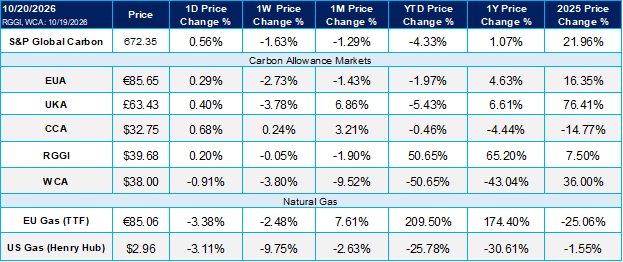
The S&P Global Carbon index was down 1.63% week over week. EUAs fell to €85.65, down 2.73%, while UKAs slipped to £63.43, down 3.78%. In North America, CCA prices edged higher to $32.75, up 0.24%, while RGGI allowances were little changed at $39.68, down 0.05%. WCA eased to $38.00, down 3.80% over the period.