EU and UK Confirm Carbon Market Linkage at Summit, California’s Q4 Auction in Focus
5 Min. Read Time
After months of media reports and market speculation, the EU-UK summit on November 20 finally confirmed that the EU and UK aim to link their carbon markets in 2028. The goal is to fully operationalize the link by January 1, 2028. We therefore expect the UK carbon allowance (UKA) discount to EU carbon allowance (EUAs) to narrow further over the coming months, having ended the week at €11/t following the summit news. That said, EUAs and UKAs both dropped sharply last week, though we felt this correction was overdue given the political sensitivity around EUA prices at €90/t.
In the US, California will publish the results of its Q4 auction this week (November 25), where we expect to see strong demand, further supporting California carbon allowances (CCAs) toward, and potentially above, $36/t into year-end.
EU and UK target January 2028 to link the EU-ETS and UK-ETS
At their summit on Friday, November 20, the EU and UK announced that they will operationalize the link between the EU-ETS and UK-ETS in 2028. The communiqué released at the conclusion of the summit stated the following:
“We welcome the conclusion of the negotiations on linking the EU and the UK Emissions Trading Systems (ETS agreement). This would provide a stable basis for allowing mutual recognition of EU and UK allowances and for exempting EU and UK goods from respective Carbon Border Adjustment Mechanisms subject to respective laws and procedures that we plan to launch without delays. We aim to apply this agreement from 2028.”
At the same time, the UK Government released its own explainer of the agreement on linking and was more specific on two crucial points, specifically that i) the target date for full operationalization is January 1, 2028, and ii) full fungibility of EUAs and UKAs in both schemes will be valid for the compliance year 2027 (with the UK aligning its compliance date with that of the EU from 2028 onwards):1
“The UK and EU are now working to implement this agreement and operationalise a link. This includes passing the necessary legislation in 2027 and delivering technical changes to the UK and EU’s registries to allow trading of allowances. This work will enable the agreement to apply from 1 January 2028. From this date, UK and EU allowances can be used interchangeably across both schemes. The first surrender deadline where UK and EU Allowances will be accepted across both schemes will be 30 September 2028, with respect to operators’ obligations for the 2027 compliance year.” (Our emphasis).
If all goes according to plan, EUAs and UKAs will be fully fungible for compliance purposes from January 1, 2028. To help meet this target, the UK Government intends to present the EU Partnerships Bill to Parliament this week. The bill will enable ‘dynamic alignment’ on emissions trading, requiring the UK to update its rules as the EU ETS evolves so that both systems continue to apply the same rules.
On the EU side, the linking agreement requires approval from the Council of the EU and the European Parliament. One potential complication in the wider UK–EU negotiations is tuition fees for EU students at UK universities: a disagreement could spill over into other areas and delay ETS linkage, keeping UKAs at a discount to EUAs.
However, the tuition-fee issue appears to have been separated from ETS linkage, with fee negotiations expected to conclude in May 2027. While some ‘tuition-fee risk’ may therefore remain priced into the UKA–EUA spread until then, we continue to expect full fungibility from January 1, 2028, for compliance with 2027 obligations.
Figure 1 shows the spread between EUAs and UKAs since the beginning of the year. On Friday, the spread closed at €11/t, but this came after a particularly turbulent week in which both EUAs and UKAs dropped sharply in response to a general risk-off sentiment in markets after EUAs hit €90/t for the second time in recent weeks, a level that has proven politically sensitive. We would now expect the spread to trend lower again and finish the year below the YTD low of €8.5/t set in January.
Figure 1: UKA discount to EUAs (Dec-26 contract), January 1 - November 20, 2026 (€/t)*
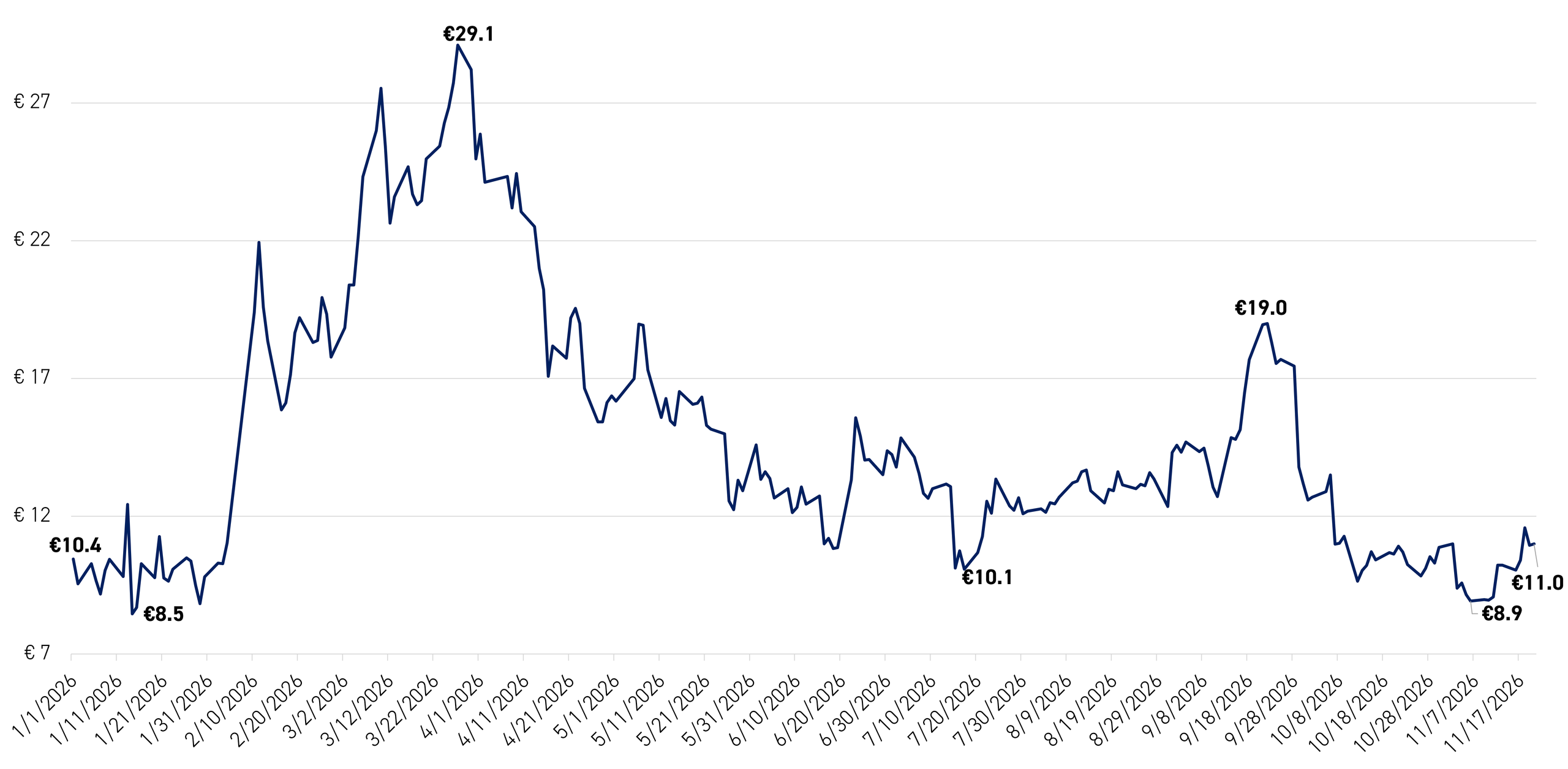
Source: Bloomberg. *Note that the chart tracks the UKA discount to EUAs in €/tonne for ease of comparison.
As far as EUAs are concerned, and ahead of Spain’s general election on November 29, we remain on alert for price-sensitive political headlines, especially with the EU Council meeting on December 17-18 in mind. Prices have now dropped twice from the €90/t level in recent weeks (most recently and sharply last week), and if opinion polls are accurate and Spain votes out the current center-left government in favor of a more climate-skeptic coalition of the center-right Partido Popular and far-right Vox parties, then the risk of political stalemate at the EU Council meeting will likely only increase (for more on the political risks currently facing the EU-ETS Review process, see our Climate Market Now post on October 21).
Final 2026 California Auction in Focus Ahead of Anticipated Market Deficits
The fourth California–Québec joint auction of the year under the Western Climate Initiative (WCI) took place on Wednesday, November 18, with results due on Wednesday, November 25.
The auction offered 49.4m current-vintage CCAs, together with 6.5m vintage 2029 (V29) allowances at the advance auction, and was the final opportunity for compliance entities to purchase allowances for Compliance Period 5 (CP5). At the same time, if Washington links with the WCI program before November 2027 – which remains our base case – these allowances would also be eligible for meeting compliance obligations in Washington’s Compliance Period 1 (CP1). We also expect the auction to attract strong interest from speculators, given that our forecasts show the WCI program will shift to consistent annual deficits from 2027.
Meanwhile, the US Bureau of Labor Statistics did not publish a CPI figure for October 2025 due to the government shutdown, leaving no basis for an October 2026 year-over-year inflation reading. The market regulator, the California Air Resources Board (CARB) will therefore likely use the year-over-year 3.7% reading from September to set its updated floor and price-containment triggers (as it did for its 2025 price escalations).
Based on the September inflation number plus the fixed 5% annual increase, we would expect the 2027 floor price to rise to $30.37/t, with the APCR Tier-1, Tier-2, and price-ceiling levels rising to $70.99/t, $91.22/t, and $111.44/t, respectively. With the Dec-26 CCA contract settling last week at $33/t, CCAs are now trading at an 18% premium to the 2026 floor. If this premium were to hold relative to the 2027 floor price implied by the September CPI reading, the Dec-26 futures contract should trade up towards $36/t through year-end.
Carbon Market Roundup
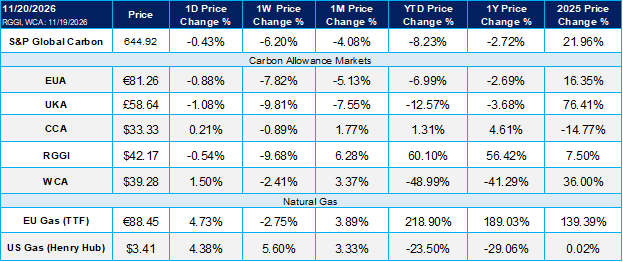
The S&P Global Carbon Credit index was down 6.20% week over week for the week ending November 20. EUAs ended at €81.26, down 7.82%, while UKAs fell to £58.64, losing 9.81%. In North America, CCA prices edged lower to $33.33, down 0.89%, while RGGI allowances declined to $42.17, down 9.68%. WCA also softened to $39.28, slipping 2.41% over the week.
- At the moment, the deadline for compliance in the EU-ETS is September 30 for emissions in the previous calendar year, while in the UK it is April 30. The UK Government explainer implies that the UK will shift its compliance deadline from April 30 to September 30, beginning in 2028.